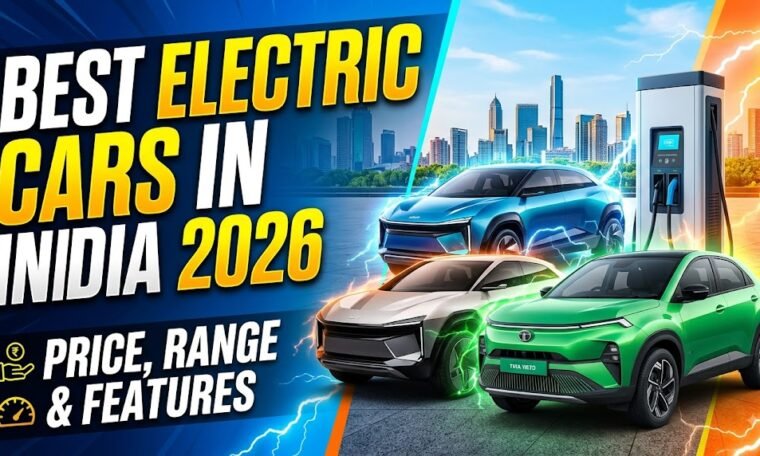
Best Electric Cars in India 2026
The best electric cars in India 2026 are no longer limited to a handful of expensive premium models. India’s EV market has expanded rapidly, with buyers now able to choose from affordable hatchbacks, compact SUVs, premium SUVs and long-range electric vehicles.
The market has also become more competitive. Tata Motors, Mahindra, MG, Hyundai, Maruti Suzuki, Kia and several international manufacturers are offering electric models across different price segments. Recent 2026 sales data shows just how quickly demand is growing: electric passenger-vehicle sales reached about 1.48 lakh units in the first half of 2026, according to recent industry data.
So, which EV should you actually consider? The answer depends on your budget, daily driving distance, charging access, family requirements and whether you regularly travel on highways.
This guide covers some of the most interesting electric cars in India in 2026, along with their prices, claimed ranges and key features.
Why Electric Cars Are Becoming Popular in India
Electric cars offer several advantages over conventional petrol and diesel vehicles.
The first is running cost. Electricity can cost less per kilometre than petrol or diesel, although the actual saving depends on electricity tariffs, charging method and driving efficiency.
EVs also have fewer moving mechanical components than conventional internal-combustion cars. This can simplify certain maintenance requirements.
Another attraction is the driving experience. Electric motors deliver instant torque, making EVs feel quick and smooth during city driving.
India’s expanding EV ecosystem is also helping. More charging infrastructure, increasing model choices and improved battery technology are making electric vehicles more practical for everyday buyers.
1. Tata Punch EV
The Tata Punch EV remains one of the most interesting options for buyers seeking a relatively affordable electric SUV-style vehicle.
Current listings show prices starting around ₹9.69 lakh, with claimed range figures varying by battery and variant.
Key Highlights
- Compact SUV design
- Multiple battery options
- Practical city-friendly dimensions
- Connected-car technology
- Modern cabin
- Multiple safety features
The Punch EV makes sense for buyers who want an electric car for everyday city commuting without moving into a higher price bracket.
2. Tata Nexon EV
The Tata Nexon EV has become one of India’s recognizable mainstream electric SUVs.
Current listings put its ex-showroom price roughly between ₹12.49 lakh and ₹17.69 lakh, depending on the variant, while claimed range figures can reach around 489km for the larger battery configuration.
Key Features
- SUV body style
- Multiple battery options
- Long-range variant
- Connected technology
- Modern infotainment system
- Practical cabin
For families wanting a familiar compact SUV format with an electric powertrain, the Nexon EV remains a strong option.
3. Tata Tiago EV
If affordability is your biggest priority, the Tata Tiago EV deserves attention.
Its listed ex-showroom price starts around ₹6.99 lakh, making it one of the more accessible electric cars in India’s mainstream market.
The Tiago EV is particularly suited to urban driving.
Why Consider It?
- Affordable entry price
- Compact dimensions
- Easy city manoeuvrability
- Multiple battery choices
- Suitable for daily commuting
It’s less about long-distance touring and more about economical urban transportation.
4. MG Windsor EV
The MG Windsor EV has quickly become an important name in India’s EV market.
Recent first-half 2026 sales data placed the Windsor at the top of the country’s electric passenger-car sales rankings, with 19,080 units sold, according to a report published today.
Current listings show prices around ₹14.70 lakh to ₹19 lakh, with claimed range figures of approximately 332km to 449km, depending on configuration.
Key Features
- Spacious cabin
- Premium interior feel
- Large infotainment display
- Comfortable rear seating
- Battery-as-a-Service option in applicable configurations
The Windsor can appeal to buyers prioritising interior space and comfort.
5. Hyundai Creta Electric
Hyundai has brought its popular Creta nameplate into the EV segment with the Creta Electric.
The vehicle is available with different battery configurations, with the larger 51.4kWh battery carrying an ARAI-claimed range of 473km. Autocar India’s real-world testing recorded approximately 432km for the long-range version.
This distinction is important.
Claimed Range vs Real-World Range
Manufacturers and testing agencies use standardized conditions to determine certified range.
Real-world driving can produce different results because of:
- Traffic
- Speed
- Air-conditioning use
- Driving style
- Road conditions
- Temperature
- Passenger and luggage load
Therefore, buyers should not judge an EV solely by its advertised range.
6. Mahindra BE 6
The Mahindra BE 6 is aimed at buyers looking for a more performance-oriented and technology-focused electric SUV.
It is offered with 59kWh and 79kWh battery options. Current listings show prices beginning around ₹18.90 lakh, while the top end extends into the high-₹20-lakh range. Claimed range figures can reach approximately 683km, depending on the variant.
Autocar India’s real-world test of the top-spec 79kWh BE 6 recorded approximately 449km.
Key Highlights
- Large battery option
- Sporty styling
- Strong performance
- Advanced cabin technology
- Long claimed range
- Premium EV architecture
The BE 6 is particularly interesting for buyers who want an electric SUV that feels more futuristic than conventional.
7. Mahindra XEV 9e
The Mahindra XEV 9e takes the company’s electric SUV formula into a more premium segment.
It uses the same broad EV architecture as the BE 6 and is available with battery options up to 79kWh.
The listed price starts around ₹21.90 lakh, while the range-topping versions can exceed ₹30 lakh. Claimed range figures reach approximately 656km.
Autocar India’s testing recorded about 456km of real-world range for the 79kWh model.
Why Buyers May Like It
- Coupe-SUV design
- Premium interior
- Large battery
- Advanced technology
- Strong highway capability
8. Tata Harrier EV
For buyers looking for a larger electric SUV, the Tata Harrier EV is one of the notable 2026 options.
Current listings put prices around ₹21.69 lakh to ₹30.43 lakh, depending on variant, with claimed ranges reaching more than 600km.
The vehicle is available with different battery configurations and rear-wheel-drive and all-wheel-drive options.
Autocar India’s test of the 75kWh AWD version produced around 401km in real-world conditions against a claimed 622km range.
Key Features
- Large SUV body
- Premium cabin
- Large battery
- AWD option
- Advanced driver-assistance features on applicable variants
- Long-distance touring potential
9. Maruti Suzuki e Vitara
The Maruti Suzuki e Vitara is one of the most important new EV entries for the Indian market because of the strength of the Maruti Suzuki brand.
Current listings show the e Vitara around ₹15.99 lakh to ₹20.01 lakh, with 49kWh and 61kWh battery options and claimed range figures reaching approximately 543km.
Key Features
- SUV design
- Two battery options
- Long-range variant
- Modern connected technology
- Familiar Maruti ownership ecosystem
The e Vitara could be particularly appealing to buyers who want an electric SUV from a brand with a large established service network.
10. Tata Sierra EV
The Tata Sierra EV adds another option to Tata’s expanding electric SUV portfolio.
Current listings show prices starting around ₹18.79 lakh, with higher variants reaching the mid-₹20-lakh range. Claimed range figures can extend to around 665km, depending on configuration.
The Sierra EV is positioned above the Nexon EV and Curvv EV in Tata’s portfolio.
Expected Appeal
- Larger SUV proportions
- Premium cabin
- Long claimed range
- Family-focused interior
- Modern electric platform
Electric Car Price in India 2026
Prices vary considerably depending on the vehicle.
| EV | Approx. Ex-Showroom Price | Claimed Range* |
|---|---|---|
| Tata Tiago EV | ₹6.99–9.99 lakh | Up to ~293km |
| Tata Punch EV | ₹9.69–12.59 lakh | Up to ~350km |
| Tata Nexon EV | ₹12.49–17.69 lakh | Up to ~489km |
| MG Windsor EV | ₹14.70–19 lakh | Up to ~449km |
| Maruti e Vitara | ₹15.99–20.01 lakh | Up to ~543km |
| Mahindra BE 6 | ₹18.90–28.49 lakh | Up to ~683km |
| Tata Sierra EV | ₹18.79–26.48 lakh | Up to ~665km |
| Mahindra XEV 9e | ₹21.90–31.25 lakh | Up to ~656km |
| Tata Harrier EV | ₹21.69–30.43 lakh | Up to ~627km |
*Figures are indicative claimed/officially listed ranges and vary by battery and variant. Prices are ex-showroom and can change.
What Range Should You Look For?
Don’t automatically choose the EV with the biggest claimed range.
If your daily driving is 30–50km and you can charge at home, a smaller battery may be sufficient.
For frequent highway travel, a larger battery and faster charging capability can become much more important.
A useful rule is to consider your actual weekly driving pattern, not just the biggest number in the brochure.
Home Charging vs Public Charging
Home charging can be one of the biggest advantages of owning an EV.
If you have a suitable parking space and charging setup, you can start many mornings with a charged vehicle.
Public fast chargers become more important during highway trips.
Before purchasing, check:
- Charger availability near home
- Charging speed
- Public charging network on regular routes
- Installation requirements
- Electricity tariff
- Parking situation
Are Electric Cars Cheaper to Run?
They can be.
EVs generally have lower energy costs per kilometre than comparable petrol cars, particularly when charged at home.
Maintenance can also be simpler because EVs don’t require conventional engine oil changes and have fewer mechanical components associated with an internal-combustion engine.
However, purchase price, insurance, financing, charging infrastructure and battery warranty should all be considered.
How to Choose the Best EV for Your Needs
For Budget Buyers
Consider smaller EVs such as the Tiago EV or Punch EV.
For Families
Nexon EV, Windsor EV, Creta Electric and larger SUVs can be considered depending on budget.
For Long Highway Trips
Look for a larger battery, strong charging capability and good real-world range.
For Performance
The Mahindra BE 6 offers a more performance-focused electric SUV experience.
For Premium SUV Buyers
The XEV 9e and Harrier EV offer larger dimensions and more premium equipment.
Final Verdict: Which Is the Best Electric Car in India 2026?
There isn’t one EV that is perfect for every Indian buyer.
The Tata Tiago EV makes sense for buyers prioritising affordability and city driving. The Tata Punch EV offers a more SUV-like package at a relatively accessible price. The Nexon EV remains an attractive mainstream family option.
For buyers seeking more space, the MG Windsor EV and Hyundai Creta Electric deserve attention. Those wanting long-range, technology-rich SUVs can look toward the Mahindra BE 6, XEV 9e, Tata Harrier EV and Sierra EV.
Meanwhile, the Maruti Suzuki e Vitara brings a major established manufacturer into the mainstream electric SUV competition.
Ultimately, the best electric car in India 2026 is the one that matches your budget, driving habits, charging access and family requirements—not simply the EV with the highest claimed range.
As India’s EV market continues expanding, buyers now have more choices than ever, making 2026 an especially interesting year for electric-car shoppers