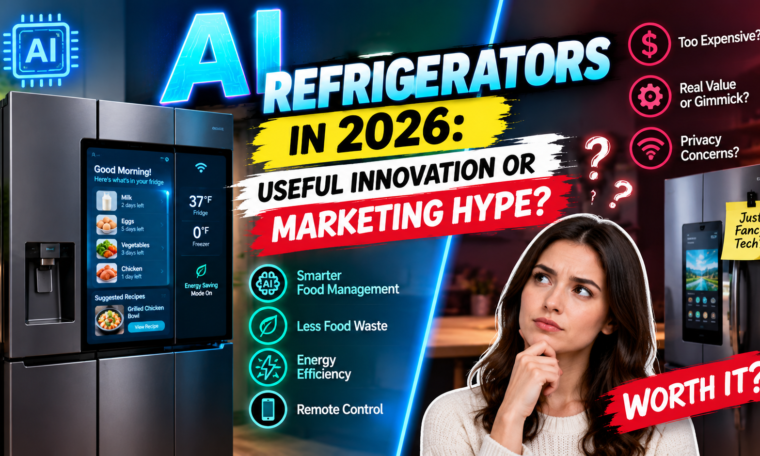
Refrigerators have come a long way from simply keeping food cold. In 2026, manufacturers are adding artificial intelligence, connected cameras, smart sensors, voice controls, and energy-management features to modern refrigerators. These products are often marketed as AI refrigerators, promising to make kitchens smarter, more convenient, and potentially more efficient.
But are AI refrigerators actually useful, or is artificial intelligence becoming another marketing term for expensive appliances?
The answer depends on what you expect from your refrigerator. Some AI-powered features can make everyday tasks easier, while others may feel unnecessary if you simply want reliable cooling and storage. Understanding what the technology actually does can help you decide whether an AI refrigerator deserves a place in your kitchen.
What Is an AI Refrigerator?
An AI refrigerator is a connected refrigerator that uses artificial intelligence, machine learning, sensors, cameras, or smart software to provide features beyond basic cooling.
Depending on the model, an AI refrigerator may recognize food items, monitor storage conditions, suggest recipes, manage temperature settings, send notifications, track expiration dates, or connect with other smart-home devices.
Some models include cameras inside the refrigerator. These cameras can help users check what is available without opening the door.
Other systems focus more heavily on energy management, diagnostics, personalization, or voice control.
The important point is that AI refrigerator features vary significantly between brands and models. The presence of an AI label does not guarantee that every refrigerator offers the same capabilities.
1. AI Food Recognition
One of the most interesting features of connected refrigerators is food recognition.
Internal cameras and AI software can potentially identify certain food items stored inside the refrigerator. The system may then use this information to help users keep track of their groceries.
Imagine standing in a supermarket and wondering whether you already have milk at home. If your refrigerator provides a connected inventory system, you may be able to check its contents through a smartphone app.
This feature can be useful for households that regularly struggle to remember what they have in the fridge.
However, food recognition is not perfect. Packaging can change, items can be hidden behind other products, and the system may not recognize every food item accurately.
Therefore, users should treat AI-generated inventories as helpful tools rather than completely reliable shopping lists.
2. Expiration and Food Management
Food waste is another area where AI refrigerators aim to provide practical benefits.
Some smart refrigerator systems can help users track food items and remind them about products that may need to be consumed soon.
For example, a connected system could provide notifications about groceries stored inside the refrigerator.
In theory, better food organization could reduce unnecessary waste and help households plan meals more effectively.
The usefulness depends heavily on how much information the system can accurately collect. Users may still need to manually update certain items, especially when groceries are moved, removed, or replaced.
3. AI-Powered Recipe Suggestions
Another popular feature involves recipe recommendations.
If the refrigerator knows which ingredients are available, its software may suggest recipes based on those foods.
For example, you might have vegetables, eggs, cheese, and leftover ingredients that need to be used. A connected refrigerator or companion app could suggest meal ideas using those ingredients.
This can be particularly convenient for people who often ask themselves, “What should I cook today?”
Still, recipe suggestions are not unique to refrigerators. Smartphone apps and AI assistants can already provide similar functionality.
The advantage of an AI refrigerator is convenience and integration rather than completely new technology.
4. Smart Temperature Management
Temperature control is one area where connected technology can provide a more practical benefit.
Sensors can monitor internal conditions and help the refrigerator maintain appropriate temperatures.
Some systems may also adjust cooling based on usage patterns or environmental conditions.
Smart temperature management can potentially help balance food preservation and energy consumption.
However, actual electricity savings vary depending on the refrigerator’s design, energy efficiency, ambient temperature, door-opening frequency, and user settings.
A refrigerator with a high-efficiency design can matter more for electricity consumption than simply having an AI feature.
5. Energy Monitoring
Energy efficiency is becoming increasingly important as electricity costs rise.
Some connected refrigerators provide information about energy consumption or allow users to monitor appliance performance through an app.
This information can help homeowners understand how the appliance operates and potentially identify unusual patterns.
For example, an unexpected increase in energy consumption could indicate a problem that requires attention.
Still, buyers should distinguish between energy monitoring and actual energy savings.
A refrigerator that tells you how much electricity it uses does not automatically consume less electricity.
The underlying compressor technology, insulation, efficiency rating, size, and operating conditions remain important.
6. Smart Diagnostics
AI and connected sensors can also make refrigerator maintenance easier.
A smart refrigerator may monitor certain components and provide notifications when something appears unusual.
For example, the system could alert users about temperature changes or potential maintenance issues.
Early notifications can help users investigate problems before they become more serious.
Remote diagnostics may also make it easier for technicians to understand a problem.
However, users should not assume that an AI diagnostic system can identify every mechanical issue. Traditional inspection and professional service may still be necessary.
7. Voice and Smart-Home Integration
Many modern AI refrigerators can connect with broader smart-home ecosystems.
Depending on compatibility, users may be able to control or monitor certain functions through a smartphone, smart display, or voice assistant.
Voice control can be convenient when your hands are busy cooking.
For example, you might check information, manage certain settings, or interact with connected kitchen functions without touching the refrigerator.
The real benefit comes when multiple devices work together rather than operating as isolated products.
Are AI Refrigerators Really Worth the Extra Cost?
This is where the marketing question becomes important.
AI refrigerators can offer useful features, but not every feature provides equal value.
A family that frequently buys groceries, wastes food, uses smart-home technology, and enjoys connected appliances may find an advanced refrigerator genuinely useful.
On the other hand, someone who simply wants reliable cooling and plenty of storage may not benefit enough from advanced AI features to justify a significantly higher price.
The technology should therefore be evaluated according to your lifestyle.
AI Features vs Traditional Refrigerator Features
When buying a refrigerator, AI should not be the only consideration.
Traditional specifications remain extremely important.
Look at:
- Energy efficiency
- Refrigerator capacity
- Freezer capacity
- Compressor technology
- Cooling performance
- Noise levels
- Build quality
- Warranty
- Service availability
- Replacement-part availability
- Door configuration
- Temperature control
After evaluating these basics, you can decide whether AI features add meaningful value.
A refrigerator with impressive AI capabilities but poor energy efficiency or limited service support may not be practical for every household.
AI Refrigerator vs Normal Refrigerator
The difference can be summarized simply.
A normal refrigerator primarily focuses on cooling, food preservation, storage, and basic temperature control.
An AI refrigerator adds connected sensors, software, cameras, automation, and potentially artificial intelligence to those traditional functions.
| Feature | AI Refrigerator | Normal Refrigerator |
|---|---|---|
| Food storage | Yes | Yes |
| Temperature control | Advanced on some models | Standard |
| Internal cameras | Available on some models | Usually unavailable |
| Food recognition | Supported on some models | No |
| Recipe suggestions | Available on some models | No |
| Smartphone connectivity | Common in smart models | Usually unavailable |
| Smart diagnostics | Available on some models | Limited |
| Energy monitoring | Available on some models | Usually unavailable |
| Voice integration | Available on compatible models | Usually unavailable |
Is AI in Refrigerators Just Marketing Hype?
Calling all AI refrigerator technology “hype” would be too simplistic.
Some features can provide genuine convenience. Food inventory tools, smart notifications, diagnostics, connected controls, and energy information can be useful in the right household.
At the same time, some AI features may have limited practical value for certain users. A refrigerator does not become dramatically better simply because it has an AI label.
The most important question is not whether the appliance uses AI. Instead, ask what the AI actually does and whether you will use it regularly.
What to Check Before Buying an AI Refrigerator in 2026
Before purchasing one, research the specific model rather than relying on general AI claims.
Check which AI features are available in your country and whether they require a separate app or subscription.
Find out which functions work without an internet connection. Review privacy controls if the refrigerator contains cameras or collects household information.
You should also investigate software-update support. Connected appliances depend on software, so long-term support can affect the experience.
Finally, compare the appliance’s energy efficiency, capacity, warranty, and service network with its price.
Final Thoughts
AI refrigerators in 2026 are more than ordinary refrigerators with flashy screens. Modern models can combine cameras, sensors, connected apps, AI-powered recognition, smart temperature management, diagnostics, recipe suggestions, and energy-related features.
However, their value depends on the individual household.
If you frequently manage groceries, want smart-home integration, or appreciate automated kitchen features, an AI refrigerator can offer meaningful convenience. If your priorities are simply reliable cooling, storage capacity, energy efficiency, and affordability, many advanced AI functions may not be essential.
Ultimately, the best way to evaluate an AI refrigerator is to ignore the marketing label for a moment and examine the actual features. If a feature solves a problem you regularly face, it may be useful. If it does not, paying extra for it may not make sense.
In 2026, the smartest refrigerator is not necessarily the one with the most AI. It is the one that provides the right combination of cooling performance, energy efficiency, reliability, convenience, and useful technology for your home.