Smartphones have changed dramatically over the past few years. Today, manufacturers are adding artificial intelligence to cameras, apps, processors, search, messaging, and even everyday tasks. This has created a new category of AI smartphones that promises to do more than traditional devices. But what actually separates an AI smartphone from a normal smartphone?
The main difference is how the phone uses AI to understand information, automate tasks, and personalize the user experience. A normal smartphone can still offer excellent performance, cameras, apps, and connectivity, while an AI smartphone adds dedicated hardware and software features designed to process AI workloads more efficiently.
If you are planning to buy a new phone in 2026, understanding the difference can help you decide whether AI features are genuinely useful for you or simply attractive extras.
What Is an AI Smartphone?
An AI smartphone is a phone designed to use artificial intelligence and machine learning for a range of everyday functions. Instead of relying entirely on traditional software instructions, these phones can analyze information and make certain tasks faster or more automated.
Modern AI smartphones may include dedicated neural processing hardware, often called an NPU or neural processing unit. This component can handle certain AI tasks without sending everything to the cloud.
For example, an AI smartphone may improve photographs automatically, summarize text, translate conversations, remove unwanted objects from pictures, organize information, or provide intelligent search features.
However, the term “AI smartphone” does not mean that every task is powered by AI. Many traditional smartphones already use machine learning for photography, security, voice recognition, and performance optimization.
What Is a Normal Smartphone?
A normal smartphone generally refers to a device that focuses on traditional smartphone functions such as calling, messaging, web browsing, social media, photography, gaming, streaming, and app usage.
These phones can still be powerful. A conventional smartphone may have a fast processor, high-quality camera system, large display, strong battery life, and advanced connectivity.
The important point is that a normal smartphone does not necessarily prioritize dedicated AI capabilities or AI-focused features in its overall design.
That does not make it outdated. In fact, many standard smartphones can perform everyday tasks extremely well without requiring advanced generative AI features.
AI Smartphones vs Normal Smartphones: Key Differences
The biggest differences appear in areas such as processing, photography, productivity, personalization, and software.
1. AI Processing
AI smartphones often include hardware specifically designed to handle machine-learning workloads.
A dedicated NPU can process certain AI operations more efficiently than a CPU alone. This can help with tasks such as image recognition, voice processing, background blur, translation, and generative AI features.
Normal smartphones can also use AI and machine learning, but their capabilities may depend more heavily on the main processor or cloud-based services.
2. Smarter Camera Features
Smartphone cameras have used computational photography for years. AI smartphones take this concept further.
An AI-powered camera can recognize scenes, adjust exposure, improve skin tones, reduce noise, sharpen details, and optimize images automatically.
Some newer phones also provide generative editing tools. Users may be able to remove unwanted objects, reposition subjects, expand an image, or create edits using text-based instructions.
For people who frequently take photos for Instagram, YouTube, blogs, or other social platforms, these tools can reduce the amount of manual editing required.
3. Generative AI Features
One of the biggest differences between AI smartphones and traditional devices is the growing use of generative AI.
Depending on the manufacturer and software, AI smartphones may offer features that can summarize notes, rewrite messages, translate text, create images, search through information, or assist with productivity.
Some features work directly on the phone, while others require an internet connection and cloud processing.
Normal smartphones can often access similar AI services through downloadable apps. The difference is that an AI-focused phone may integrate these tools more deeply into the operating system.
4. Voice Assistants and Natural Language
Voice assistants are not new. However, AI smartphones are increasingly designed to understand more natural conversations.
Instead of giving a simple command such as “set an alarm,” users may be able to ask more complicated questions or request multiple actions.
Advanced AI assistants can potentially understand context and follow-up questions better than older voice assistants.
Still, capabilities vary significantly between devices, software versions, languages, and regions.
5. On-Device AI vs Cloud AI
Another important difference involves where AI processing takes place.
On-device AI processes information directly on the smartphone. This can provide faster responses for certain tasks and may reduce the need to send some information to remote servers.
Cloud-based AI, on the other hand, sends data to remote servers for processing. Cloud systems can offer access to much larger AI models, although they generally require an internet connection.
Many modern AI smartphones use a combination of both approaches.
6. Personalization
AI can help smartphones understand user habits and preferences.
For example, AI-powered software may learn which apps you use frequently, optimize battery performance, organize information, or provide personalized suggestions.
The goal is to make the phone feel more responsive to individual needs.
However, personalization also raises privacy questions. Users should check what information a device collects, where processing occurs, and what controls are available.
7. Productivity Features
AI smartphones can be particularly useful for students, professionals, creators, and people who frequently work from their phones.
AI tools can help summarize long documents, generate notes, translate content, correct writing, transcribe recordings, and organize information.
These features can save time when used appropriately.
A normal smartphone can perform many of these tasks through third-party applications, but an AI smartphone may offer them directly through built-in software.
Are AI Smartphones Faster Than Normal Smartphones?
Not necessarily.
This is one of the biggest misconceptions surrounding AI smartphones.
AI capabilities and overall performance are not exactly the same thing. A smartphone with advanced AI hardware is not automatically faster at gaming, opening apps, or browsing the internet.
Overall performance depends on several factors, including the chipset, RAM, storage, software optimization, cooling system, and display technology.
An AI smartphone’s main advantage is its ability to handle specific AI workloads efficiently.
Do AI Smartphones Have Better Cameras?
Not automatically.
Camera quality depends on the sensors, lenses, image-processing system, software, and tuning. AI can improve computational photography, but artificial intelligence cannot completely compensate for weak camera hardware.
When comparing phones, look at actual camera specifications and real-world photo performance rather than choosing a phone simply because it is marketed as an AI device.
Are AI Smartphones Worth Buying in 2026?
Whether an AI smartphone is worth buying depends on how you use your phone.
If you regularly edit photos, create content, translate languages, summarize information, use voice tools, or rely heavily on productivity features, integrated AI could be genuinely useful.
On the other hand, if you mainly use your smartphone for WhatsApp, Instagram, YouTube, calls, browsing, photography, and basic apps, a conventional smartphone may already provide everything you need.
Price also matters. Some AI features may be available through apps on less expensive smartphones, so buyers should compare the complete package rather than focusing only on the AI label.
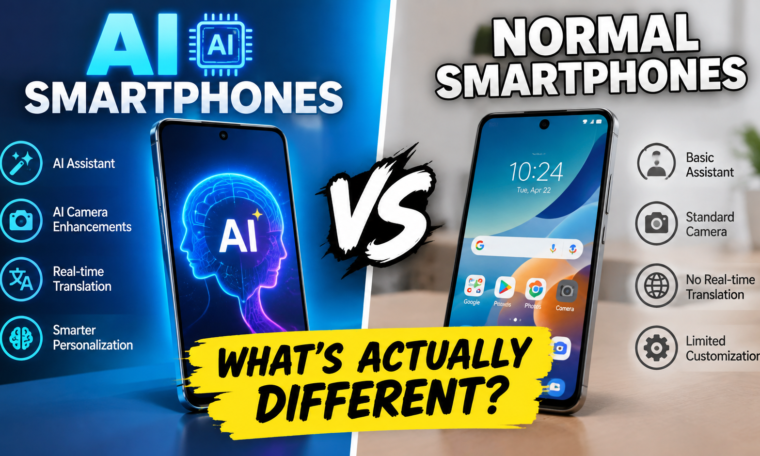
AI Smartphones vs Normal Smartphones: Quick Comparison
| Feature | AI Smartphones | Normal Smartphones |
|---|---|---|
| AI processing | Often includes dedicated AI hardware | Usually relies mainly on standard processing hardware |
| Camera optimization | Advanced AI-assisted features | Computational photography may still be available |
| Generative AI | Often deeply integrated | Usually available through apps |
| Voice features | More advanced AI capabilities on some models | Basic to advanced depending on software |
| Personalization | More AI-driven features | Traditional software-based personalization |
| On-device AI | Common in newer models | Available on some devices |
| Productivity | Built-in AI tools may be extensive | Often requires separate apps |
| Price | Can be higher depending on model | Available across a wider price range |
What Should You Look For When Buying an AI Smartphone?
Don’t buy a phone simply because the word “AI” appears in its specifications.
Instead, check whether the AI features solve problems you actually have.
Look at the processor and NPU, camera hardware, battery life, software support, privacy controls, storage, display, and long-term update policy.
You should also check whether important AI features work offline or require a subscription or internet connection. Some advanced tools may have usage limits or vary by region.
Most importantly, compare real features instead of marketing claims.
The Future of AI Smartphones
AI is likely to become a more integrated part of smartphones rather than remaining a separate feature.
Future devices may understand context better, automate repetitive tasks, provide more personalized assistance, improve photography, and connect AI services across different apps.
The distinction between an “AI smartphone” and a traditional smartphone may also become less obvious as AI capabilities become standard across more devices.
Instead of asking whether a phone has AI, consumers may eventually ask which AI features it offers, how well they work, and how much they cost.
Final Thoughts
The difference between AI smartphones vs normal smartphones is mainly about integration and capability. AI smartphones are designed to handle more artificial-intelligence workloads through dedicated hardware and software. They can offer advanced photography, generative AI, voice assistance, productivity tools, translation, and personalization.
However, a normal smartphone can still deliver excellent everyday performance. For many users, advanced AI features may not be essential.
The smartest approach is to compare the features you actually need. If AI tools can save you time or improve the way you create, communicate, and work, an AI smartphone may offer meaningful benefits. If not, a traditional smartphone can still be a practical choice in 2026.