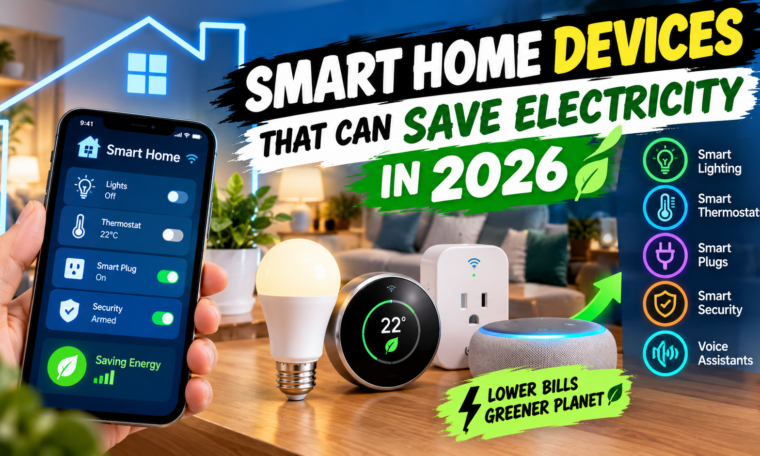
Electricity costs can add up quickly when lights, fans, air conditioners, televisions, appliances, and other devices run throughout the day. In 2026, smart home technology offers homeowners more ways to monitor and control energy consumption. From smart plugs to connected thermostats and energy-monitoring systems, these devices can help reduce unnecessary electricity use while making everyday routines more convenient.
However, simply buying a smart device does not automatically lower your electricity bill. The real savings come from using automation, scheduling, monitoring, and energy-efficient settings correctly.
So, which smart home devices can save electricity in 2026, and how do they work? Let’s explore the most useful options.
What Are Energy-Saving Smart Home Devices?
Energy-saving smart home devices are connected products that allow you to monitor, control, or automate electricity-consuming equipment.
Many of these devices connect to a smartphone app or smart home platform through Wi-Fi, Bluetooth, Zigbee, or another wireless technology. Depending on the product, you can create schedules, turn devices off remotely, monitor energy consumption, or automate equipment based on your routine.
For example, a smart plug can switch off a device automatically after a specific period. Similarly, a smart thermostat can adjust heating or cooling based on occupancy and schedules.
The biggest benefit is better control over energy usage.
1. Smart Plugs
Smart plugs are among the simplest ways to make existing appliances smarter.
You plug the smart device into an electrical outlet and then connect an appliance to it. The plug can usually be controlled through an app or voice assistant.
Some advanced smart plugs also include energy-monitoring features. These models can show how much electricity a connected appliance consumes.
That information can be useful when identifying energy-hungry devices around your home.
For instance, you could use a smart plug for a television, desk setup, lamp, router, or other compatible appliance. You can then schedule the plug to turn off automatically when you normally go to sleep.
How Smart Plugs Can Save Electricity
Smart plugs can reduce unnecessary runtime and help prevent appliances from staying powered when you don’t need them.
They can also make it easier to manage standby power consumption for compatible devices. However, not every appliance should be connected to a smart plug, so always check the plug’s electrical rating and the appliance manufacturer’s guidance.
2. Smart LED Bulbs
Traditional incandescent bulbs can consume considerably more electricity than modern LED lighting. Smart LED bulbs combine LED efficiency with connected controls.
Users can schedule lights, turn them off remotely, dim brightness, and sometimes automate lighting based on routines.
For example, you can create an evening schedule that turns selected lights on and then switches them off automatically at bedtime.
Dimming can also reduce energy use when full brightness isn’t necessary.
Why Smart Lighting Matters
The biggest advantage is not necessarily the smart feature itself. LED technology already provides efficient lighting. Smart controls add another layer by making it easier to avoid leaving lights switched on unnecessarily.
3. Smart Thermostats and AC Controllers
Cooling can represent a significant portion of household electricity consumption in warm climates.
Smart thermostats and compatible smart AC controllers can help manage cooling schedules and temperature settings. Some systems can adjust operation based on occupancy, time, or other conditions.
Instead of running cooling equipment at the same setting throughout the day, you can create schedules that match your actual routine.
For example, cooling can be adjusted when everyone leaves home and returned to a comfortable setting before people come back.
Smart AC Controls for Indian Homes
In India, smart AC controllers can be particularly useful for compatible air conditioners. They can allow users to control temperature, schedules, and operating modes from a smartphone.
However, actual electricity savings depend on factors such as AC efficiency, room insulation, outdoor temperature, temperature settings, and how long the system operates.
4. Smart Energy Monitors
Sometimes the biggest problem is not knowing where your electricity is going.
Smart energy monitors can provide information about household electricity consumption. Depending on the system, you may be able to see usage patterns through an app or dashboard.
This data can help identify appliances or periods when electricity consumption rises.
For example, you may discover that cooling equipment consumes far more electricity than expected or notice unusually high overnight consumption.
Once you understand the pattern, you can make targeted changes instead of guessing.
5. Smart Power Strips
A smart power strip can help manage multiple connected devices at once.
This can be useful for entertainment centers, computer desks, and home-office setups where several devices remain connected to the same power source.
Some smart power strips can automatically switch selected outlets off according to schedules or activity.
For example, a home-office power strip could turn off accessories after your normal working hours.
Smart power strips can therefore help reduce unnecessary power consumption from devices that remain connected when they are not being used.
6. Smart Fans
Smart fans can provide better control over when and how cooling operates.
Depending on the model, users may be able to schedule operation, adjust speed remotely, or integrate the fan with other smart-home routines.
A fan generally consumes less electricity than an air conditioner, although the actual consumption depends on the fan’s motor, speed, operating time, and design.
Using a smart fan alongside sensible temperature settings can sometimes reduce the need to run an air conditioner continuously.
7. Smart Appliances
Many modern appliances now include connected features.
Smart refrigerators, washing machines, dishwashers, and other appliances may provide energy information, scheduling options, or operating modes designed around efficiency.
For example, a connected washing machine may allow you to schedule cycles at convenient times. Some appliances can also provide notifications when a cycle finishes, which can make household routines easier to manage.
Still, the “smart” label does not automatically mean an appliance uses less electricity. Always check its actual energy-efficiency specifications.
8. Smart Water Heaters
Water heating can consume substantial electricity, particularly when a heater runs for longer than necessary.
Smart water-heater controls can allow users to schedule heating around their daily routine.
Instead of keeping water hot continuously, you may be able to heat it during periods when hot water is actually needed.
Some connected systems can also provide temperature controls and usage information.
The potential savings depend heavily on the heater type, insulation, household usage, and settings.
9. Smart Curtains and Blinds
Smart blinds may seem less important than smart plugs or energy monitors, but they can contribute to better temperature management.
During hot weather, automatically closing blinds during strong sunlight can help reduce heat entering a room. During cooler periods, opening curtains at appropriate times can allow natural sunlight to warm indoor spaces.
That can potentially reduce the workload on cooling or heating systems.
Smart blinds become more useful when integrated with schedules, sensors, or broader home-automation routines.
How Much Electricity Can Smart Home Devices Save?
There is no single percentage that applies to every household.
Electricity savings depend on the devices already installed, usage habits, climate, appliance efficiency, home insulation, and how automation is configured.
A smart plug that turns off a rarely used lamp will not produce the same savings as better management of a frequently used air conditioner.
Therefore, the best strategy is to identify your home’s biggest electricity-consuming devices first.
Smart Home Automation for Electricity Savings
Automation is where connected devices can become particularly useful.
You can create routines that combine multiple devices.
For example:
“Good Night” routine:
- Turn off selected lights.
- Switch off entertainment equipment.
- Adjust the AC or thermostat.
- Turn off compatible smart plugs.
Another routine could reduce energy use when nobody is home.
“Away” routine:
- Turn off unnecessary lights.
- Disable selected plugs.
- Adjust cooling settings.
- Close compatible smart blinds.
These routines reduce the number of manual decisions you need to make every day.
Things to Check Before Buying Smart Energy Devices
Before purchasing a smart home product, consider its actual energy-saving potential.
First, check whether the device measures electricity consumption or simply provides remote control.
Next, verify compatibility with your existing appliances and smart-home ecosystem.
Security and privacy also matter. Connected devices should receive regular software updates, and users should use strong passwords and appropriate account security.
Finally, calculate the purchase cost. A smart device makes more financial sense when its expected electricity savings and convenience justify its price.
Final Thoughts
Smart home devices that can save electricity in 2026 include smart plugs, LED bulbs, AC controllers, energy monitors, smart power strips, connected fans, smart appliances, water-heater controls, and automated blinds.
Their biggest advantage is control. Instead of leaving appliances running according to habit, you can monitor consumption, create schedules, automate routines, and identify unnecessary electricity use.
Still, smart technology is only one part of energy efficiency. Efficient appliances, sensible temperature settings, proper insulation, and good daily habits remain important.
The smartest home is not necessarily the one with the most connected devices. It is the one where technology helps you understand and control how electricity is actually being used.