OLED vs QLED vs Mini-LED: Which TV Is Better?
Choosing a new television isn’t as simple as picking the biggest screen anymore. Walk into an electronics store or browse online, and you’ll quickly encounter terms such as OLED, QLED and Mini-LED. But what do these technologies actually mean, and which one gives you the best viewing experience?
The OLED vs QLED vs Mini-LED debate has become especially important because all three technologies can deliver excellent picture quality. However, they approach image creation differently, which affects contrast, brightness, colours, viewing angles, gaming performance and price.
What Is OLED TV Technology?
OLED stands for Organic Light-Emitting Diode.
Unlike traditional LCD-based televisions, OLED panels don’t require a conventional backlight to illuminate the screen. Individual pixels can produce their own light and can switch off completely when displaying black.
That ability gives OLED one of its biggest advantages: extremely deep blacks and excellent contrast.
Imagine watching a movie scene set in a dark room. An OLED television can turn off pixels in the darkest parts of the scene, creating a very deep black background while keeping bright objects visible.
Main OLED Advantages
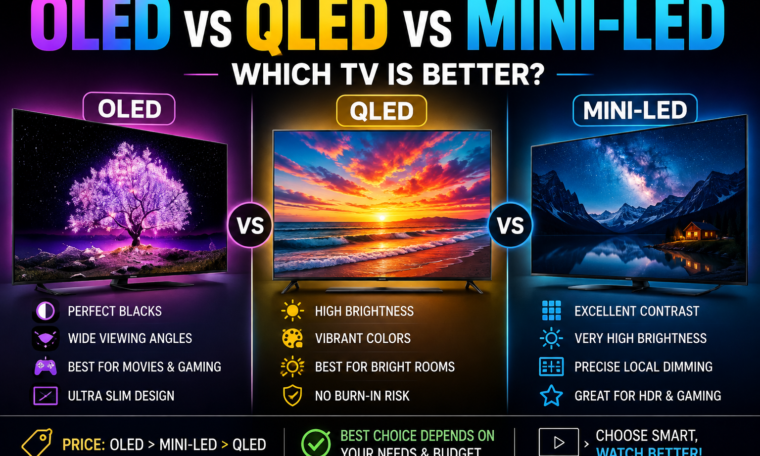
- Excellent black levels
- Outstanding contrast
- Excellent viewing angles
- Fast response times
- Thin panel designs
- Highly cinematic picture quality
- Excellent for movies and gaming
OLED is particularly appealing to viewers who watch movies in darker rooms and want a premium cinematic experience.
What Is QLED TV Technology?
QLED stands for Quantum Dot Light-Emitting Diode, although modern QLED televisions are generally still LCD TVs that use LED backlighting alongside a quantum-dot layer.
The quantum-dot technology helps improve colour reproduction and brightness.
Unlike OLED, a QLED television uses a backlight. That means its pixels cannot individually switch completely off in the same way OLED pixels can.
However, QLED TVs can become extremely bright, making them attractive for rooms with lots of natural light.
Main QLED Advantages
- High brightness
- Vivid colours
- Good HDR performance
- Excellent for bright rooms
- Large screen options
- Generally less concern about OLED-style image retention
For people who watch television during the day in a brightly lit living room, QLED can be a very practical choice.
What Is Mini-LED TV Technology?
Mini-LED is another type of LCD television technology, but it uses much smaller LED backlights than conventional LED TVs.
Because the LEDs are smaller, manufacturers can place many more of them behind the display and divide them into numerous local-dimming zones.
That allows the television to control brightness more precisely.
The result can be significantly better contrast than conventional LCD televisions while maintaining the high brightness that LCD technology is known for.
Main Mini-LED Advantages
- Very high brightness
- Strong HDR performance
- Improved contrast
- Excellent for bright rooms
- Good gaming performance
- Reduced risk of permanent burn-in compared with OLED
Mini-LED is often viewed as a middle ground between traditional LCD/QLED technology and OLED.
OLED vs QLED vs Mini-LED: Picture Quality
Picture quality is probably the biggest reason people compare these three technologies.
OLED
OLED generally has the strongest advantage when it comes to black levels and contrast because individual pixels can turn off.
This makes dark movie scenes look particularly impressive.
QLED
QLED TVs can produce vibrant colours and high brightness. However, traditional QLED models may not match OLED’s black levels because the display still relies on a backlight.
Mini-LED
Mini-LED improves upon conventional LCD technology by providing more precise local dimming.
Depending on the specific television, a good Mini-LED model can deliver impressive contrast while maintaining greater brightness than many OLED TVs.
Winner for overall contrast: OLED
Winner for brightness: Mini-LED/QLED
Which TV Is Best for Bright Rooms?
If your living room receives strong sunlight, brightness becomes particularly important.
A television that looks fantastic in a dark room may struggle with reflections and ambient light during the day.
This is where QLED and Mini-LED TVs can be attractive.
Their strong brightness can help maintain a vivid picture even when sunlight enters the room.
OLED televisions have improved significantly in brightness, but if your primary viewing environment is extremely bright, a high-performance Mini-LED or QLED TV may be worth considering.
Best Choice for Bright Rooms
Mini-LED or QLED
Which TV Is Best for Dark Rooms?
For a dedicated home theatre or bedroom where you usually watch television with the lights dimmed, OLED has a major advantage.
Because OLED pixels can switch off individually, dark scenes can appear exceptionally deep.
Movies with lots of shadows, night scenes and space sequences can look especially impressive.
Best Choice for Dark-Room Movie Watching
OLED
OLED vs QLED vs Mini-LED for Gaming
Gaming requires more than attractive colours.
Gamers should consider:
- Refresh rate
- Response time
- Input lag
- HDMI features
- Variable refresh rate
- Resolution
- HDR
- Motion handling
OLED’s extremely fast pixel response makes it particularly appealing for fast-moving games.
Mini-LED TVs can also be excellent gaming displays, especially when combined with high refresh rates and gaming-focused features.
QLED models can offer strong gaming performance as well, particularly in the mid-range and premium segments.
Best for Competitive Gaming
OLED
Best for Bright-Room Gaming
Mini-LED
However, always check the specifications of the exact TV model. Panel technology alone doesn’t determine gaming performance.
Which Has Better Colours?
Colour performance has become excellent across all three technologies.
OLED can produce rich and accurate colours while maintaining excellent contrast.
QLED uses quantum dots to enhance colour reproduction and can produce a very bright, vibrant image.
Mini-LED is primarily a backlight technology rather than a completely different panel type, so its colour performance depends on the underlying LCD and quantum-dot implementation.
For everyday viewing, you may find all three impressive.
The bigger differences often appear in contrast, brightness and local dimming rather than basic colour quality.
What About HDR Performance?
HDR, or High Dynamic Range, is designed to create a greater range between dark and bright parts of an image.
A television’s HDR performance depends on several factors, including:
- Peak brightness
- Black levels
- Contrast
- Local dimming
- Colour volume
- HDR format support
OLED can create beautiful HDR images because bright objects can appear against extremely dark backgrounds.
Mini-LED can also be outstanding for HDR because its high brightness allows highlights to become very intense.
QLED models can provide strong HDR performance as well, particularly higher-end models.
Best HDR Experience
There isn’t one universal winner.
OLED excels in contrast, while Mini-LED can excel in brightness. Your viewing environment and the specific model matter greatly.
OLED vs QLED vs Mini-LED: Burn-In Concerns
Burn-in is one of the topics most frequently discussed when people consider OLED.
Because OLED pixels produce their own light, prolonged display of static elements can potentially contribute to permanent image retention over time.
Modern OLED televisions include various technologies designed to reduce this risk, and normal mixed viewing is generally very different from displaying the same static image continuously.
Still, people who watch channels with persistent logos, use a TV as a computer monitor for long periods or play the same game interface for extremely long sessions may prefer an LCD-based Mini-LED or QLED model.
Best for People Concerned About Burn-In
QLED or Mini-LED
Which TV Lasts Longer?
There isn’t a simple answer because television lifespan depends on usage, brightness settings, operating conditions and the specific panel.
OLED technology has matured significantly, while QLED and Mini-LED televisions also have their own components that can eventually experience wear.
Rather than choosing a television solely because you expect one technology to last forever, consider the manufacturer’s warranty, build quality and your typical usage pattern.
A high-quality television that suits your lifestyle is usually a better investment than choosing a technology based only on theoretical lifespan.
Which Is More Energy Efficient?
OLED can be efficient when displaying darker content because individual pixels can turn off.
However, power consumption varies significantly depending on brightness, screen size and what is being displayed.
A large, very bright television can consume considerably more energy regardless of its panel category.
Therefore, don’t assume one technology will always use less electricity. Check the energy specifications for the exact model you’re considering.
OLED vs QLED vs Mini-LED Price
Price is another major consideration.
OLED has traditionally occupied the premium portion of the TV market, although more affordable OLED options have become available.
QLED televisions cover a broad range of prices, from relatively affordable models to premium sets.
Mini-LED can also range from mid-range to high-end depending on screen size, backlight sophistication and other features.
Rather than asking which technology is cheapest, compare televisions within your actual budget.
OLED vs QLED vs Mini-LED Comparison
| Feature | OLED | QLED | Mini-LED |
|---|---|---|---|
| Black levels | Excellent | Good to very good | Very good |
| Contrast | Excellent | Good | Excellent |
| Brightness | Very good | Excellent | Excellent |
| Colours | Excellent | Excellent | Excellent |
| Viewing angles | Excellent | Varies | Varies |
| Gaming response | Excellent | Very good | Very good |
| Bright rooms | Very good | Excellent | Excellent |
| Dark rooms | Excellent | Very good | Excellent |
| Burn-in concern | Possible | Very low | Very low |
| HDR | Excellent | Very good | Excellent |
| Price range | Mid to premium | Budget to premium | Mid to premium |
Remember that this is a technology-level comparison. Individual TV models can perform very differently.
OLED vs QLED vs Mini-LED: Which One Should You Buy?
The best option depends on how you use your television.
Choose OLED If:
- You prioritise movie quality.
- You watch in a dark room.
- Deep blacks matter to you.
- You want excellent viewing angles.
- You play fast-paced games.
- You’re comfortable paying more for premium picture quality.
Choose QLED If:
- You want a bright and colourful picture.
- Your budget is more limited.
- You watch mostly during the day.
- You want a wide variety of screen sizes and price points.
- You don’t want to worry much about image retention.
Choose Mini-LED If:
- You want high brightness and strong contrast.
- You watch in a bright room.
- HDR performance is important.
- You’re concerned about OLED burn-in.
- You want a premium LCD-based display.
OLED vs QLED vs Mini-LED for Netflix and Movies
Movie lovers often appreciate OLED because cinematic content benefits from excellent contrast and deep blacks.
However, Mini-LED can be an outstanding alternative, particularly if you have a bright living room.
QLED is also perfectly capable of delivering a vibrant and enjoyable movie experience, especially when paired with a strong local-dimming system.
For a dark home theatre:
OLED is the strongest choice.
For a bright family room:
Mini-LED can be an excellent choice.
Common Mistakes When Buying a New TV
Don’t choose a television based only on the word “OLED,” “QLED” or “Mini-LED.”
Consider the complete specification sheet.
Look at:
- Screen size
- Resolution
- Refresh rate
- HDR support
- HDMI ports
- Gaming features
- Sound quality
- Operating system
- Warranty
- Viewing distance
- Room brightness
A well-designed Mini-LED television can be a better purchase for one person, while an OLED may be better for another.
Final Verdict: OLED vs QLED vs Mini-LED
So, OLED vs QLED vs Mini-LED: which TV is better?
There isn’t one winner for everyone.
OLED is the best choice for viewers who prioritise deep blacks, contrast, viewing angles and cinematic picture quality. It is especially attractive for movies and gaming in darker rooms.
QLED is a versatile choice for people who want bright, colourful images and a broad selection of televisions across different price ranges. It can be particularly practical for bright living rooms.
Mini-LED is arguably the most interesting middle ground. It combines LCD-based brightness with much more sophisticated backlighting and can deliver impressive contrast and HDR performance without the same burn-in considerations associated with OLED.
Ultimately, your room, budget, viewing habits and priorities should determine the purchase.
If you’re a movie enthusiast with a dark room, OLED is difficult to beat. For a bright family room, QLED or Mini-LED may make more sense. And if you want powerful brightness, strong HDR and excellent contrast in one package, Mini-LED deserves serious consideration.
The smartest TV purchase isn’t necessarily the one with the most impressive technology name. It’s the one that delivers the right combination of picture quality, features, price and reliability for the way you actually watch television.