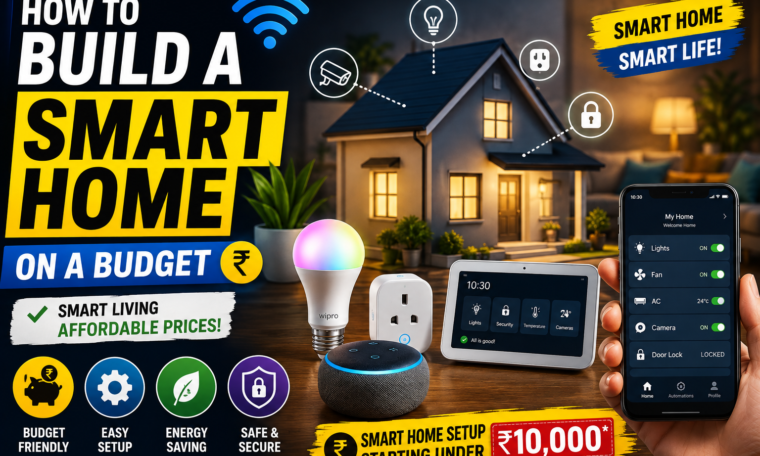
How to Build a Smart Home on a Budget in 2026
You don’t need a luxury villa or a massive technology budget to create a smart home. In 2026, how to build a smart home on a budget has become a much easier question to answer because affordable smart bulbs, plugs, speakers, cameras and other connected devices are widely available.
The trick is not to buy everything at once.
Instead, identify everyday problems and use technology to solve them.
A ₹600 smart bulb that makes your lighting easier to control may provide more value than an expensive connected appliance with features you never use.
Here’s how to build an affordable smart home step by step.
1. Start With a Smart Bulb
Smart bulbs are one of the easiest entry points.
Depending on the model, you can control:
- Brightness
- Colour temperature
- Colours
- Schedules
- On/off settings
Some Indian-market smart bulbs are available for around ₹500–₹700, although prices vary by brand and retailer.
Start with one room rather than replacing every bulb.
2. Add a Smart Plug
Smart plugs are another inexpensive way to introduce automation.
You can use compatible plugs with suitable lamps and other devices.
For example, you could schedule a lamp to turn on in the evening.
Always check electrical ratings before connecting high-power appliances.
3. Choose a Smart Speaker
A smart speaker can become a convenient control centre.
You can use voice commands for timers, music, reminders and compatible smart devices.
Before buying, check which ecosystem works best with the products you already own.
4. Create Simple Routines
The real magic of a smart home comes from routines.
Instead of controlling devices individually, create simple automated sequences.
For example:
Good Morning: Lights turn on and your speaker provides reminders.
Movie Time: Compatible lights dim and entertainment devices switch modes.
Good Night: Selected lights turn off.
The exact possibilities depend on the devices and platform.
5. Add Smart Security Carefully
Security cameras and smart doorbells can be useful additions.
However, don’t buy the cheapest camera without checking privacy and security features.
Look for:
- Strong account security
- Two-factor authentication
- Regular software updates
- Appropriate storage options
- Good night vision
- Reliable notifications
Security should always come before convenience.
6. Consider a Robot Vacuum Later
Robot vacuums can be useful but are usually more expensive than smart bulbs or plugs.
If cleaning takes up a significant amount of your time, a robot vacuum could provide meaningful value.
If your budget is limited, however, save it for later.
You don’t need one to call your home “smart.”
7. Don’t Replace Working Appliances
This is probably the most important money-saving rule.
If your refrigerator works perfectly, don’t replace it just because a new model has Wi-Fi.
If your washing machine is reliable, don’t upgrade simply for app connectivity.
Smart-home upgrades should solve problems rather than create unnecessary expenses.
8. Choose One Smart-Home Ecosystem
Compatibility can become confusing when you mix too many platforms.
Before buying a new device, check:
- Does it work with your existing assistant?
- Does it support the same ecosystem?
- Does it support Matter if relevant?
- Can devices communicate with each other?
- Does the app have good reviews?
Planning ahead can prevent you from ending up with five different apps.
9. Protect Your Wi-Fi Network
Your smart home depends heavily on your network.
Use a strong Wi-Fi password and keep your router firmware updated.
If your router supports separate guest networks, consider using them for suitable devices.
Also keep smart-device software updated.
Recent smart-home coverage has highlighted the importance of local control and offline functionality because internet outages can affect cloud-dependent features.
10. Think About Electricity Consumption
Smart devices themselves use electricity, although usually in relatively small amounts.
The bigger issue is the appliances they control.
Smart automation can potentially help prevent devices from being left on unnecessarily, but savings depend on how the system is configured.
Automation should support good habits—not replace them.
Budget Smart Home Setup
A basic setup could look like this:
Stage 1: Smart bulb
Stage 2: Smart plug
Stage 3: Smart speaker
Stage 4: Security camera
Stage 5: Additional lighting or automation
Stage 6: Robot vacuum or smart appliance when your budget allows
This gradual approach keeps spending under control.
Smart Home Budget Mistakes to Avoid
Buying Everything at Once
Start small.
Choosing Devices Only by Price
Cheap isn’t always better if the app is unreliable or security support is poor.
Ignoring Compatibility
Make sure your devices can work together.
Buying Features You Don’t Need
A touchscreen doesn’t automatically make an appliance better.
Ignoring Security
Every connected device should be treated as part of your digital environment.
How Much Money Do You Need?
A basic smart-home setup can be created for a relatively modest amount if you start with bulbs and plugs.
A more advanced system involving multiple cameras, smart locks, speakers, robot vacuums and connected appliances can cost tens of thousands of rupees.
There is no fixed budget.
Your smart home should grow according to your needs.
Is a Smart Home Worth It?
Yes—when the technology solves real problems.
If you constantly forget to turn off lights, automation can help.
If you want to monitor your entrance remotely, a smart camera may be useful.
If cleaning consumes a large amount of your time, a robot vacuum could be worthwhile.
But if a device doesn’t make your life easier, don’t buy it simply because it’s trendy.
Final Thoughts
Learning how to build a smart home on a budget is really about making strategic choices.
Start with inexpensive devices such as smart bulbs and plugs. Add a speaker if voice control appeals to you. Consider security devices when needed, and upgrade to smart appliances only when your existing appliances require replacement.
Most importantly, build your smart home gradually.
You don’t need every gadget available in 2026.
A truly smart home is not the one with the most devices. It’s the one where technology makes everyday life simpler, safer and more convenient without wasting money.