Smartphones have become more personal than ever. We use them for banking, private messages, passwords, work documents, shopping, social media, and even sensitive health or financial information. However, there is one privacy problem that software cannot completely solve: people around you can see your screen.
That is where privacy displays on smartphones could become an important new phone feature.
Traditional privacy screen protectors have already offered a simple solution by narrowing the viewing angle. However, they can make displays darker and affect the normal viewing experience. New built-in privacy display technology aims to solve that problem by controlling how much of the screen can be seen from different angles.
Samsung has already brought this concept to a commercial smartphone with the Galaxy S26 Ultra. Its built-in Privacy Display can limit side-angle visibility while keeping the screen clearer for the person looking directly at it.
So, could privacy displays become the next major smartphone trend?
What Is a Privacy Display on a Smartphone?
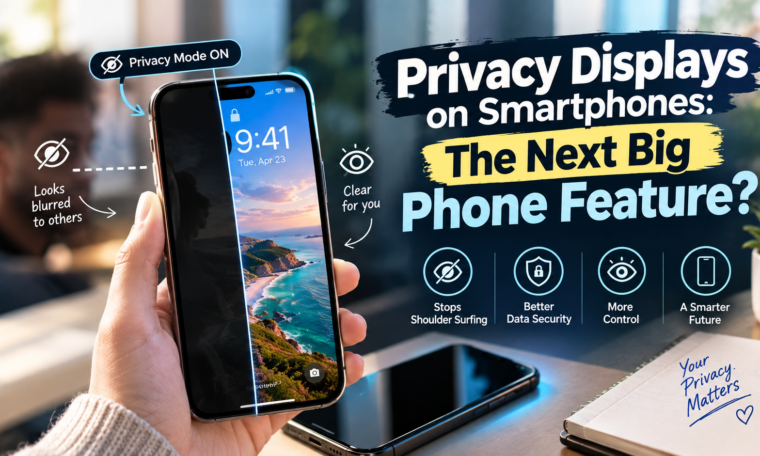
A smartphone privacy display is display technology designed to reduce the visibility of your screen from side angles.
Normally, modern phone displays are designed to provide wide viewing angles. That is useful when you want to show a photo or video to someone sitting next to you. Unfortunately, the same wide viewing angle can expose private information to strangers.
Privacy display technology takes the opposite approach.
When privacy mode is activated, the display changes how light reaches viewers outside the intended viewing angle. The person looking directly at the phone can continue to see the content, while people viewing from the side see a significantly darker or less visible screen.
Samsung describes its Privacy Display as a built-in technology that can control screen visibility and reduce peripheral viewing.
This makes it different from simply placing a privacy film over the screen.
How Does Smartphone Privacy Display Technology Work?
The technology behind privacy displays is more sophisticated than a conventional screen protector.
Samsung Display’s Flex Magic Pixel technology, for example, uses a panel-integrated approach designed to control how light is emitted from OLED pixels. Samsung says the technology can keep content clear from the front while making it much darker from other viewing angles.
Samsung has also explained that its Privacy Display can dynamically control the display’s pixels. The result is a screen that remains useful to the primary viewer while limiting what people nearby can see.
In simple terms, imagine holding a flashlight inside a narrow tube. You can see the light when you look straight through the tube, but someone standing beside it sees much less.
A privacy display applies a similar concept to smartphone screen light, but through advanced display engineering.
Why Are Privacy Displays Important?
Think about the places where you normally use your smartphone.
You might check your bank balance while sitting on a train. You could enter a password while waiting at an airport. Perhaps you read a private message in a crowded café.
In all of these situations, someone nearby may accidentally or intentionally see your screen.
This behavior is commonly known as shoulder surfing.
A built-in privacy screen can reduce this risk by making the display harder to view from the side. Samsung specifically positions its Privacy Display as protection for situations such as public transportation and other crowded environments.
The technology becomes particularly useful as smartphones handle more sensitive information.
Built-In Privacy Screen vs Privacy Screen Protector
For years, consumers have been able to purchase privacy screen protectors. These accessories use physical filters to restrict viewing angles.
They are affordable and easy to install, but they also have limitations.
A privacy film can make the screen appear darker even when you are looking directly at it. It can also make it harder to show something to another person. In addition, some protectors can affect screen clarity or viewing comfort.
Built-in privacy display technology takes a different approach.
Instead of permanently placing a filter over the screen, the phone can activate privacy protection when needed. Samsung says Galaxy S26 Ultra users can customize Privacy Display for different situations rather than keeping the feature active all the time.
That flexibility could make built-in privacy displays more attractive to everyday smartphone users.
The Galaxy S26 Ultra Has Already Introduced the Concept
The biggest evidence that privacy displays could become a broader smartphone trend is already here.
Samsung introduced the Galaxy S26 Ultra with what it describes as the world’s first built-in Privacy Display on a mobile phone. The feature can limit side-angle visibility and can be customized for different situations.
Users can configure the feature to protect the entire screen or use more selective options. Samsung’s support documentation says Privacy Display can be configured for supported apps, notifications, and certain password-entry situations.
That approach is important because privacy does not always need to be active.
For example, you may want a normal wide viewing angle when showing a friend a photograph. At the same time, you may want stronger protection while entering a banking password.
Privacy Displays Could Become Smarter
The next stage of this technology could involve more automation.
Instead of manually switching privacy mode on and off, future smartphones could potentially activate it based on the situation. For example, a phone could use software settings, app categories, or other contextual signals to determine when additional screen privacy makes sense.
Samsung already provides condition-based controls on the Galaxy S26 Ultra, allowing users to configure situations in which Privacy Display activates.
This points toward a broader trend in smartphone design: privacy protection that works automatically in the background.
As phones become more intelligent, privacy features may also become more personalized.
Banking and Passwords Could Be Major Use Cases
Financial apps are one of the clearest examples of where privacy displays can help.
Imagine checking your bank account balance while standing in a crowded queue. A traditional display allows people standing nearby to potentially read the information.
With privacy display technology enabled, the viewing angle becomes much more restricted.
The same principle applies to passwords, PINs, authentication screens, personal messages, and confidential work information.
Samsung specifically supports privacy settings for certain sensitive situations, including password entry and supported financial or personal applications.
However, users should remember that a privacy display is not an absolute security guarantee. Samsung itself notes that some information may remain visible depending on viewing angle, brightness, and surrounding conditions.
Will Privacy Displays Affect Screen Quality?
This is one of the biggest questions for smartphone manufacturers.
Consumers expect flagship displays to deliver excellent brightness, color accuracy, contrast, and viewing angles. A privacy feature should ideally add protection without creating major compromises.
Modern display engineering is moving toward that goal.
Samsung Display says its Flex Magic Pixel technology combines privacy functionality with OLED display technologies designed for brightness and efficiency. The company also announced that the technology received privacy-performance verification from UL Solutions.
Independent testing reported by Android Authority found a major reduction in brightness at wider viewing angles when the privacy technology was active.
Still, privacy modes can change the viewing experience outside the intended viewing angle. Therefore, manufacturers will need to balance privacy, brightness, efficiency, and image quality.
Could Privacy Displays Become Standard on Phones?
The answer will depend on cost, consumer demand, and how quickly manufacturers can integrate the technology into different display panels.
The Galaxy S26 Ultra shows that built-in privacy protection is commercially possible. However, one flagship device does not automatically mean every smartphone will adopt the feature.
Display manufacturers would need to make the technology affordable enough for more devices. Smartphone brands would also need to decide whether consumers consider privacy protection important enough to justify the additional hardware and engineering.
There is another important factor: privacy is becoming a bigger part of smartphone design.
Phones now contain personal conversations, payment information, authentication details, photographs, work files, and AI-generated or AI-assisted content. As the amount of sensitive information stored on phones increases, protecting what appears on the screen becomes more relevant.
What Could Future Privacy Displays Offer?
Future privacy displays on smartphones could become more advanced in several ways.
1. Automatic Privacy Mode
Phones could automatically activate privacy protection when users open banking, password, or confidential work applications.
2. Custom Viewing Zones
Users might eventually control exactly how wide the viewing angle should be.
3. Better Brightness
Future panels could maintain high brightness for the main viewer while strongly reducing side visibility.
4. Lower Power Consumption
Display manufacturers could optimize privacy technology so that stronger protection does not significantly increase battery consumption.
5. More Smartphone Models
The technology could eventually move from premium flagship phones into mid-range smartphones as manufacturing becomes more efficient.
Privacy Displays Are More Than a Gimmick
Some smartphone features mainly improve convenience or entertainment. Privacy displays address a more practical problem.
Your phone is a private device, but you often use it in public.
That contradiction makes screen privacy particularly interesting. A person may use a phone for highly sensitive tasks while sitting just a few centimeters away from strangers.
Built-in privacy display technology attempts to create a digital boundary around the screen without requiring an external accessory.
Samsung’s implementation shows that the concept has moved beyond laboratory demonstrations and into an actual consumer smartphone.
The bigger question now is whether other manufacturers will follow.
Final Thoughts
Privacy Displays on Smartphones could become one of the more useful display innovations of the next few years.
The technology addresses a simple but increasingly important problem: keeping private information private when using a phone in public. Built-in solutions can potentially offer more flexibility than traditional privacy screen protectors by allowing users to activate protection only when they need it.
The Galaxy S26 Ultra has already demonstrated one commercial approach, with customizable privacy settings for the full screen, selected applications, notifications, and sensitive activities.
Whether privacy displays become a standard feature across smartphones will depend on cost, display quality, battery efficiency, and consumer demand.
For now, though, the direction is clear. Smartphone displays are no longer only about being brighter, sharper, or faster. The next generation may also need to know who should be able to see them.