For decades, personal robots existed mainly in science fiction. Movies and television shows imagined intelligent machines that could clean homes, carry objects, answer questions, and help people with everyday tasks.
That idea is now moving closer to reality.
The rise of personal AI robots is being driven by rapid advances in artificial intelligence, computer vision, robotics, sensors, and machine learning. Instead of simply following a fixed set of commands, newer robots can increasingly understand their surroundings, recognize objects, respond to spoken instructions, and learn how to perform physical tasks.
Companies such as 1X and Figure are developing humanoid robots specifically for home environments. Meanwhile, the wider robotics industry is moving from impressive demonstrations toward practical applications. Global humanoid robot sales reached about 7,000 units in 2025, according to the International Federation of Robotics, although most were still used in industrial, professional, or research settings rather than ordinary homes.
So, what is driving this change, and what could personal AI robots actually do?
What Are Personal AI Robots?
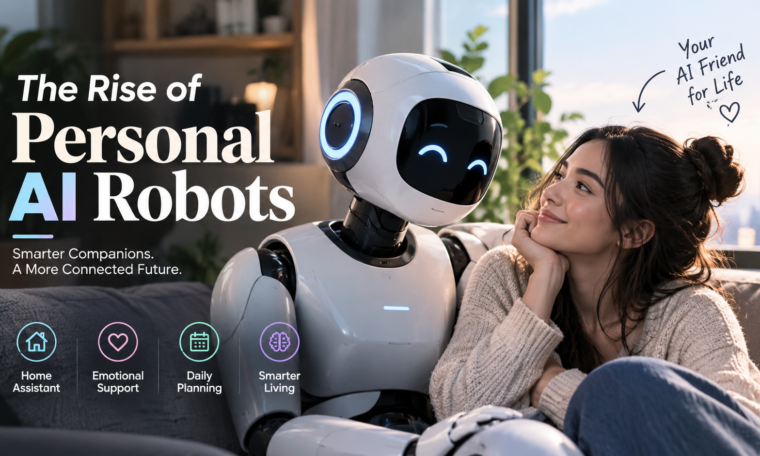
Personal AI robots are physical machines designed to assist individuals in homes or other everyday environments using artificial intelligence.
Traditional household robots usually perform one specific task. A robot vacuum, for example, can clean floors, but it cannot normally prepare a meal, carry laundry, or answer questions.
AI-powered robots aim to be much more flexible.
A personal AI robot could potentially understand a spoken request such as “bring me the water bottle,” locate the object, navigate around furniture, pick it up, and deliver it to the user.
That combination of physical movement and artificial intelligence is often described as embodied AI.
The robot does not simply generate an answer on a screen. Instead, it uses AI to understand the physical world and take action inside it.
Why Are Personal Robots Becoming Possible Now?
Several technologies have matured at the same time.
Modern AI models can understand language, images, sounds, and increasingly complex instructions. At the same time, robotics hardware has improved through better cameras, sensors, motors, batteries, processors, and control systems.
The result is a new generation of robots that can connect perception, reasoning, and physical movement.
Figure’s Helix 02, for example, uses a unified neural system to coordinate walking, manipulation, and balance. Figure demonstrated the system completing a dishwasher task autonomously across a full-sized kitchen.
These developments matter because homes are far more complicated than controlled factories.
A home contains stairs, pets, children, furniture, different lighting conditions, fragile objects, and constantly changing layouts. A useful personal robot must handle all of those variables.
Home Robots Are Becoming More General-Purpose
The biggest change in robotics is the move toward general-purpose robots.
Instead of building one machine for one task, companies are attempting to create robots capable of learning many different activities.
1X’s NEO is an example of this approach. The company describes NEO as a consumer-oriented humanoid designed for household chores and personal assistance. Its current product information highlights tasks such as putting away dishes, responding to voice commands, managing chores, and learning additional capabilities.
Figure is pursuing a similar direction with Figure 03, which the company describes as a general-purpose humanoid designed for everyday home tasks. The robot was redesigned with home-oriented features including softer materials, improved audio, wireless charging, and hardware intended for larger-scale manufacturing.
These projects show how the definition of a robot assistant is changing.
What Could a Personal AI Robot Do?
The potential applications are broad.
Household Chores
Cleaning and organizing could become major use cases.
A personal robot could potentially pick up objects, move dishes, organize items, assist with laundry, or perform other repetitive activities.
The important difference is flexibility. Instead of buying separate machines for different jobs, one general-purpose robot could potentially handle multiple tasks.
Object Retrieval
Simple physical assistance could also be valuable.
Imagine sitting at a desk and asking a robot to bring a package from the doorway or retrieve something from another room.
That task sounds simple, but it requires the robot to understand language, navigate the home, identify the correct object, grasp it safely, and return without hitting anything.
Assistance for Older Adults
Personal AI robots could also provide physical assistance to people who have difficulty completing certain household activities.
A robot might help retrieve objects, carry lightweight items, provide reminders, or connect users with family members.
However, safety and reliability will be particularly important when robots operate around people who may be physically vulnerable.
AI Companion
Personal robots will not necessarily focus only on physical work.
AI-powered robots can also communicate through voice, remember preferences, answer questions, tell stories, and provide information.
1X’s NEO, for example, includes conversational capabilities, memory, visual intelligence, and an integrated large language model according to the company’s product information.
This combination could make future robots feel more like personal assistants than traditional appliances.
The Importance of Embodied AI
One of the most important technologies behind personal AI robots is embodied AI.
Generative AI can already understand text and images remarkably well. A robot, however, must understand physical consequences.
If a robot receives the instruction “put the glass on the table,” it must recognize the glass, understand where the table is, estimate how much force to use, move its arm, grasp the glass, and place it without breaking it.
That requires a connection between intelligence and physical action.
Figure’s recent Helix research focuses on this problem. In September 2026, the company announced Helix 2.5 and reported testing across 30 different homes to study whether a humanoid could generalize its learned abilities to unfamiliar environments.
This kind of generalization could be essential before home robots become genuinely useful at scale.
Personal AI Robots Still Have Major Challenges
Despite impressive demonstrations, the technology is not yet equivalent to having a human assistant.
The first challenge is reliability.
A robot might successfully complete a task in a demonstration but struggle when the environment changes. Real homes are unpredictable, and small differences can create major problems for robotic systems.
Safety presents another challenge.
A powerful machine moving through a home must avoid people, pets, furniture, stairs, and fragile objects. Developers need reliable control systems and physical designs that reduce the consequences of accidental contact.
Cost is also significant.
1X announced NEO with a $20,000 Early Access purchase option and a $499-per-month subscription option, with initial deliveries planned for the U.S. in 2026.
That pricing shows that personal humanoid robots remain very different from ordinary consumer electronics.
Privacy Could Become a Major Issue
Personal AI robots could collect significantly more information than today’s smart speakers or security cameras.
A robot moving through a home could potentially see rooms, people, documents, personal belongings, and daily routines. Microphones could also capture conversations.
Consequently, privacy will become an important part of consumer acceptance.
Manufacturers will need to explain how robots store data, where AI processing happens, who can access recordings, and whether humans can remotely supervise the robot.
The issue becomes even more important when robots use cloud services or remote operators to assist with unfamiliar tasks.
Users will likely want strong controls over cameras, microphones, recordings, remote access, and personal information.
Why 2026 Is an Important Year
The year 2026 represents an interesting transition point for personal robotics.
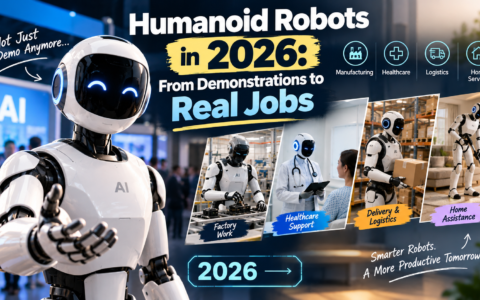
Humanoid robots are no longer limited to research laboratories. Companies are testing them in factories, warehouses, and increasingly realistic home environments. At the same time, consumer-focused products are beginning to emerge.
However, the industry is also facing pressure to demonstrate real-world value rather than relying only on impressive demonstrations. Reuters reported in September 2026 that Chinese regulators were scrutinizing humanoid robotics companies amid concerns about hype and commercial demand.
That shift is important.
The next phase of the robotics industry will depend less on whether a robot can walk or perform a flashy demonstration. The bigger question will be whether it can reliably perform useful tasks for ordinary people.
Will Personal AI Robots Become Common?
There is no guarantee that humanoid robots will become common household products.
The technology still needs improvements in autonomy, safety, battery life, reliability, manufacturing costs, and AI reasoning.
Some companies may succeed while others may change direction or abandon consumer products. Samsung’s Ballie is an example of how difficult the consumer robotics market can be. The company had previously promoted the rolling home robot but later shifted Ballie away from an expected consumer launch.
Therefore, the future of personal robots remains an evolving market rather than an established consumer category.
The Future of Personal AI Robots
If the technology continues to improve, personal robots could eventually become another layer of smart-home technology.
Today’s smart home connects lights, speakers, thermostats, cameras, and appliances. Tomorrow’s home could include a physical AI system capable of interacting with many of those devices while also moving through the environment.
Instead of saying, “Turn on the kitchen light,” users might simply ask a robot to prepare a room for dinner.
Instead of programming a machine for one task, people could describe what they want in ordinary language.
That would represent a major shift in human-computer interaction.
The interface would no longer be only a screen or voice assistant. The AI itself would have a physical presence.
Final Thoughts
The rise of personal AI robots marks an important development in both artificial intelligence and robotics.
Advances in embodied AI are allowing robots to understand physical environments, while better hardware is making complex movement and manipulation increasingly possible. Companies such as 1X and Figure are already developing humanoids specifically for home environments.
Still, significant challenges remain. Reliability, safety, cost, privacy, battery life, and real-world autonomy must improve before personal robots become ordinary household products.
The most interesting part of this technology is not simply that robots can walk like humans. It is that AI is beginning to move out of computers and into the physical world.
If that transition continues, the personal robot may eventually become as familiar as the smartphone, smart speaker, or robot vacuum — not just answering questions, but actually helping people get things done.