Artificial intelligence has quickly become one of the biggest features in modern smartphones. AI can now summarize information, translate conversations, edit photos, detect scams, generate content, and help users complete everyday tasks.
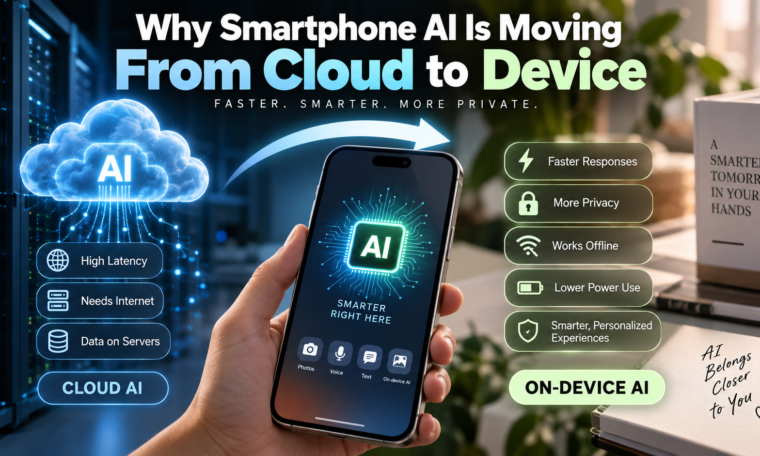
For years, many of these AI experiences depended heavily on cloud computing. A smartphone would collect information, send it to a remote server, wait for the server to process it, and then receive the result.
That model is changing.
Smartphone AI is increasingly moving from the cloud to the device itself. New mobile processors now include dedicated neural processing hardware, while companies such as Apple, Google, Samsung, and Qualcomm are building AI experiences that can perform at least some tasks directly on smartphones.
Apple’s latest Apple Intelligence architecture, for example, combines on-device models with Private Cloud Compute for tasks that require more powerful server-based processing. Qualcomm is also promoting mobile platforms designed to run generative AI directly on smartphones.
So why is the smartphone becoming an AI computer instead of simply being a window into cloud AI?
What Is On-Device AI?
On-device AI means that an artificial intelligence model processes information directly on a smartphone rather than sending every request to a remote server.
Imagine asking your phone to summarize a note.
With a cloud-based system, the information may need to travel to a data center before the AI produces a response. With on-device AI, a compatible model can process the request locally.
Modern smartphones achieve this using specialized hardware called a Neural Processing Unit (NPU) or a similar AI accelerator. These processors are designed to handle machine-learning workloads efficiently without relying entirely on the main CPU.
Qualcomm says its current mobile platforms are designed to run large generative AI models directly on devices, offering benefits such as responsiveness, privacy, and personalization.
Why Is Smartphone AI Moving Away From the Cloud?
The move is not about completely replacing cloud AI. Instead, smartphone manufacturers are building a hybrid AI model in which smaller or routine tasks run locally while more demanding workloads can use cloud infrastructure.
Several factors are driving this change.
1. Faster AI Responses
Speed is one of the biggest advantages of on-device AI.
Cloud AI depends on network connectivity. Even a powerful AI service can feel slower when a connection is weak or congested.
Local processing removes much of that network delay.
A smartphone can process compatible AI tasks directly through its NPU and return the result without waiting for information to travel between the device and a remote server.
That becomes particularly useful for real-time features such as camera processing, voice recognition, translation, and call assistance.
Qualcomm highlights low latency as one of the main advantages of running AI directly on mobile hardware.
2. Better Privacy
Privacy is another major reason for the shift toward on-device AI.
Smartphones contain an enormous amount of personal information. Messages, photographs, contacts, documents, location data, passwords, and conversations can all reveal details about a person’s life.
Processing some of that information locally means it does not necessarily need to leave the smartphone.
Apple has built its current Apple Intelligence architecture around both on-device processing and Private Cloud Compute. Apple says that when Private Cloud Compute handles more complex requests, user data is not stored or made accessible to Apple.
Google and Samsung are also using on-device AI for selected features. For example, Google says scam detection on Galaxy S26 devices uses an on-device Gemini model, with call analysis performed directly on the device.
This approach could make local AI increasingly important for sensitive smartphone tasks.
3. AI Can Work Without the Internet
Another advantage is offline functionality.
Cloud AI normally requires an internet connection because the model runs on remote infrastructure. On-device AI can continue working when a phone has limited or no connectivity, provided the necessary model and features are stored locally.
That could be useful while traveling, during flights, in areas with poor network coverage, or when users simply want to reduce their dependence on an internet connection.
Not every AI feature can work offline. Large models can require significant processing power and memory. Still, smaller optimized models are making local AI increasingly practical.
4. Smartphones Are Getting More Powerful
The smartphone hardware needed for local AI has improved dramatically.
Modern mobile chips combine CPUs, GPUs, NPUs, memory systems, and other specialized components to handle increasingly complex workloads.
Qualcomm’s Snapdragon platforms, for example, use dedicated AI hardware to support generative AI, computer vision, speech processing, and other AI workloads. The company’s current mobile AI platform describes support for large language models and multimodal experiences running on-device.
This hardware improvement is one of the biggest reasons AI-powered smartphones are becoming more capable.
The phone is no longer just a communication device. It is becoming a small AI computer that can perform machine-learning tasks locally.
5. Smaller AI Models Are Changing the Game
One major development behind on-device AI is the creation of smaller, optimized AI models.
Traditional large language models can contain enormous numbers of parameters and require substantial computing resources. Putting such models directly on a smartphone would be difficult.
Developers are therefore creating smaller models designed specifically for mobile hardware.
Apple’s latest foundation-model architecture includes dedicated on-device models, including a 3-billion-parameter model and a more powerful multimodal on-device model.
Qualcomm is also expanding tools that help developers optimize and deploy generative AI models on compatible devices. Its AI Hub provides models optimized for different mobile chipsets and use cases.
These developments make local AI more practical.
6. Personalized AI Works Better on the Device
Personalization could become one of the biggest benefits of smartphone artificial intelligence.
Your smartphone already knows a lot about your habits. It can contain your calendar, messages, photos, contacts, applications, preferences, and other personal information.
An AI assistant that can securely use some of that context could provide more useful responses.
For example, an AI assistant might understand which meeting you are preparing for, recognize information in your photos, summarize a collection of personal notes, or help organize your day.
Qualcomm’s current mobile AI strategy emphasizes local context and personalized AI agents that can use information available on the device.
Local processing can make these experiences more responsive while reducing the amount of personal information that needs to be sent to the cloud.
Cloud AI Is Not Disappearing
Despite the growth of on-device AI, cloud computing still has an important role.
Some AI tasks are simply too demanding for a smartphone. Larger models may require more memory, computing power, or specialized infrastructure than a mobile device can efficiently provide.
This is why companies are increasingly using a hybrid approach.
Apple’s Private Cloud Compute is a clear example. Apple describes a system in which some AI models run on the device while more complex workloads can move to secure server infrastructure.
The future is therefore unlikely to be completely local or completely cloud-based.
Instead, smartphones will increasingly decide where each AI task should run.
AI Agents Could Accelerate the Shift
The next major stage could involve AI agents.
A traditional AI assistant waits for a question and provides an answer. An AI agent can potentially understand a goal, use multiple tools, and help complete a series of tasks.
Google’s 2026 Android developments are moving toward more proactive AI experiences, including Gemini features designed to automate complex tasks and simplify activities such as form filling.
Qualcomm is similarly describing a future where mobile AI agents understand personal context and take action across different applications and devices.
For these experiences to feel natural, low latency will matter.
Nobody wants to wait several seconds every time an AI agent performs a simple action. Local processing could make these interactions feel much more immediate.
What Are the Challenges?
Moving AI onto smartphones also creates challenges.
The first issue is battery consumption. AI workloads can require significant processing power, and continuous AI activity could reduce battery life.
The second challenge is hardware cost. Advanced NPUs and additional memory can increase the complexity and cost of smartphone processors.
Another concern is model size. Smaller models are easier to run locally, but they may not match the capabilities of the largest cloud-based models for every task.
Security also matters. Keeping AI models on a device does not automatically make every AI interaction completely private or secure.
Manufacturers therefore need to balance performance, battery life, privacy, cost, and AI capability.
What Does This Mean for Future Smartphones?
The shift toward on-device AI could change how consumers choose smartphones.
Instead of comparing phones only by camera megapixels, display refresh rates, and processor speed, buyers may increasingly look at AI hardware and local AI capabilities.
Future smartphones could offer:
- More powerful offline AI assistants
- Real-time translation
- Faster photo and video editing
- Private document summarization
- Intelligent call assistance
- Personalized recommendations
- AI-powered search
- Local voice transcription
- Context-aware AI agents
- Smarter camera processing
The important change is that AI could become less visible.
Rather than opening a separate AI application, users may simply notice that their phone understands more, responds faster, and performs more tasks automatically.
The Future Is Hybrid AI
The biggest misconception about the move from cloud to device is that cloud AI will disappear.
That is unlikely.
Instead, smartphones are heading toward hybrid AI, where the device and cloud work together.
Simple, sensitive, or latency-critical tasks can run locally. More complicated workloads can move to secure cloud infrastructure when necessary.
This approach gives manufacturers more flexibility while allowing users to benefit from both local and cloud computing.
Apple’s current architecture already follows this model by combining on-device foundation models with Private Cloud Compute.
Qualcomm is also describing a future in which on-device intelligence, edge computing, and cloud resources cooperate to create more responsive personal AI experiences.
Final Thoughts
Why is smartphone AI moving from cloud to device? The answer comes down to speed, privacy, personalization, offline functionality, and increasingly powerful mobile hardware.
Smartphones are gaining dedicated AI processors, smaller optimized models, and software designed specifically for local intelligence. At the same time, companies are developing hybrid systems that combine on-device processing with cloud resources when larger models are required.
The result could be a new generation of smartphones where AI feels less like an internet service and more like a built-in part of the device.
The cloud will remain important. However, the smartphone itself is becoming much smarter.
As mobile processors continue to improve, on-device AI could become one of the defining features of smartphones in the next few years.