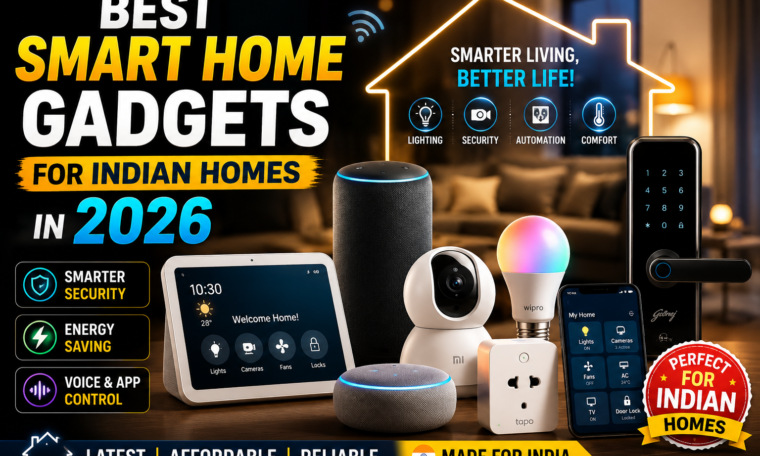
Best Smart Home Gadgets for Indian Homes in 2026
The idea of a smart home is no longer limited to luxury apartments or futuristic houses. In 2026, smart home gadgets are becoming increasingly practical for Indian households, helping people improve security, automate everyday tasks, control appliances remotely and make daily routines more convenient.
From a simple smart bulb that responds to voice commands to a robot vacuum that cleans your floor automatically, there are now gadgets for almost every room in the house. Recent Indian technology coverage highlights smart security cameras, speakers and robot vacuum cleaners among the useful connected devices available to consumers.
The best part? You don’t have to transform your entire house overnight. A few carefully selected devices can create a useful smart-home setup without spending a fortune.
What Is a Smart Home?
A smart home uses internet-connected devices that can be controlled automatically, through a smartphone app, voice commands or scheduled routines.
For example, you could say, “Turn off the living room lights,” check your security camera while you’re away, or schedule a smart plug to switch an appliance on or off.
Modern smart-home systems can connect several devices together, creating automated routines. However, compatibility remains important because different devices may use different ecosystems and standards. Industry research also suggests that ease of setup, reliability, interoperability and clear everyday value remain important factors for wider smart-home adoption in India.
1. Smart Bulbs
Smart bulbs are among the easiest ways to start building a smart home.
Instead of using only a traditional wall switch, you can control compatible bulbs using an app or voice assistant. Many models allow users to adjust brightness, change colour temperature and create schedules.
For Indian homes, look for bulbs with the correct socket type, strong Wi-Fi connectivity and compatibility with your preferred smart-home platform.
Best for: Bedrooms, living rooms, study rooms and decorative lighting.
Why buy one? They are relatively affordable and don’t require major electrical modifications.
2. Smart Plugs
A smart plug can turn an ordinary electrical appliance into a remotely controllable device.
You simply connect the smart plug to a wall socket and plug your appliance into it. Depending on the model, you can then control power through an app, voice assistant or schedule.
Smart plugs can be particularly useful for lamps, chargers, fans and other compatible appliances.
Before buying, check the plug’s maximum supported load and ensure it is suitable for the appliance you plan to connect.
Best for: Renters, beginners and people who don’t want to replace existing appliances.
3. Smart Security Cameras
Home security is one of the strongest reasons to consider smart technology.
Modern smart security cameras can provide remote monitoring through a smartphone app. Depending on the model, features may include motion detection, night vision, two-way audio, human detection and real-time notifications.
Some cameras support cloud storage, while others allow local storage through a microSD card.
For Indian homes, consider whether you need an indoor or outdoor camera, whether your Wi-Fi signal reaches the installation location and how your footage will be stored.
Best for: Home security, monitoring children or pets and checking your home while travelling.
4. Smart Video Doorbells
A smart video doorbell combines a traditional doorbell with a camera and connected features.
When someone approaches your door, compatible models can send an alert to your smartphone. You may also be able to see the visitor and communicate through two-way audio.
This can be especially useful for apartments, independent houses and families that regularly receive deliveries.
When buying one, check video quality, night vision, storage options, installation requirements and compatibility with your existing door or electrical setup.
5. Smart Speakers
A smart speaker can become the voice-control centre of a smart home.
Devices compatible with platforms such as Alexa or Google Home can control compatible lights, plugs and other gadgets. They can also play music, set reminders, provide information and manage routines.
A smart speaker is particularly useful when multiple devices are connected because you don’t need to open a separate app every time you want to perform a basic action.
Best for: Voice control, music, reminders and smart-home routines.
6. Robot Vacuum Cleaners
If there is one smart gadget that can genuinely reduce household chores, it may be the robot vacuum cleaner.
These devices can automatically navigate around your home and clean floors according to schedules or commands. Higher-end models may combine vacuuming and mopping and use advanced navigation to map rooms.
For Indian homes, consider suction performance, mopping capability, navigation, obstacle avoidance and the ability to handle dust and hair.
Robot vacuums are particularly useful for busy households where daily floor cleaning can become time-consuming.
7. Smart Door Locks
Smart locks can make home entry more convenient while adding additional security features.
Depending on the model, users may unlock doors through fingerprints, PINs, RFID cards, smartphone apps or physical keys.
Some smart locks can also provide access records or temporary access codes.
However, door compatibility is extremely important. Measure your existing lock and door before purchasing, and choose a product with a reliable mechanical override.
Best for: Apartments, villas, rental properties and families that want keyless entry.
8. Smart Air Purifiers
Air quality is an important consideration for many Indian households, particularly in cities where pollution and dust can become concerns.
A smart air purifier can provide real-time information about indoor air quality and allow users to control settings through an app or automation.
Some models can automatically adjust their purification level according to detected air conditions.
When choosing one, focus on room coverage, filtration technology, replacement-filter costs and noise levels rather than simply buying the device with the most features.
9. Smart AC Controllers
Air conditioners can consume substantial electricity, especially during hot Indian summers.
A smart AC controller can add connected functionality to certain existing air conditioners by using infrared signals. Depending on the device, you may be able to control temperature, operating modes and schedules through your smartphone.
This can be useful if you sometimes forget to switch off the AC before leaving home.
Smart AC control is therefore not only about convenience; scheduling and better usage habits may also help manage energy consumption.
10. Smart Fans
Fans are essential in many Indian homes, making smart fans and smart fan controllers particularly relevant.
Some newer fans offer app-based controls, timers and voice commands. Another option is installing a compatible smart regulator to add connected functionality to an existing fan.
For a new fan purchase, consider a BLDC motor, which can offer energy-efficiency advantages compared with conventional fan motors.
The most important thing is to ensure that any smart regulator or installation is electrically compatible with your fan and wiring.
11. Smart Sensors
Smart sensors are small devices, but they can make a home considerably more automated.
Motion sensors can trigger lights, door sensors can notify you when an entry point opens, and water-leak sensors can alert you to leaks near sinks or washing machines.
Instead of simply controlling your home remotely, sensors allow your smart home to respond automatically to what is happening.
For example, a motion sensor could turn on a hallway light when someone enters at night.
12. Smart Projectors for Home Entertainment
Smart projectors are another interesting addition to modern homes.
Recent Indian launches show that affordable projectors are increasingly offering features such as Android operating systems, Wi-Fi connectivity, Bluetooth and automatic image correction.
A smart projector can turn a bedroom or living room into a home cinema without requiring a large television.
However, brightness, resolution, speaker quality and room lighting should be considered before buying.
How to Build a Smart Home on a Budget
You don’t need to spend ₹50,000 or ₹1 lakh to start.
A simple beginner setup could include:
- One smart bulb
- One smart plug
- One smart speaker
- One security camera
Once you become comfortable with these devices, you can add a smart lock, sensors, robot vacuum or smart AC controller.
Affordable connected devices are increasingly available in India, making gradual adoption possible for households with different budgets.
Which Smart Home Gadgets Should You Buy First?
If you’re completely new to smart-home technology, prioritize devices that solve a real problem.
For convenience: Smart bulbs and smart plugs are excellent starting points.
For security: Consider a smart camera, video doorbell or smart lock.
For cleaning: A robot vacuum can save time.
For energy management: Smart plugs, smart AC controls and efficient smart fans can be useful.
For entertainment: A smart speaker or projector can upgrade your home experience.
The goal isn’t to fill your house with gadgets. The goal is to make everyday life easier, safer and more efficient.
What to Check Before Buying Smart Home Devices
Before purchasing any smart gadget, check these important factors:
Compatibility
Make sure the device works with the ecosystem you already use, such as Alexa or Google Home.
Wi-Fi Requirements
Check whether the gadget requires a 2.4GHz network, 5GHz connectivity or another protocol.
Privacy and Security
Security cameras, microphones and other connected devices can collect sensitive information. Choose reputable brands, use strong passwords and enable available security features.
After-Sales Support
A cheap gadget isn’t necessarily a bargain if replacement parts, software support or customer service are difficult to find.
Total Cost
Don’t consider only the purchase price. Check subscription fees, replacement filters, batteries, installation costs and accessories.
The Future of Smart Homes in India
The smart-home market is moving toward greater integration. Instead of having ten separate apps for ten different devices, consumers increasingly want gadgets that work together smoothly.
Recent industry research suggests that the next phase of smart-home growth in India will depend heavily on simplicity, interoperability, trust, energy savings, safety and practical everyday benefits.
Standards such as Matter are also becoming increasingly relevant because interoperability can make it easier for compatible devices from different manufacturers to work together.
The future smart home isn’t necessarily the one with the most gadgets. It is the one where technology quietly handles repetitive tasks in the background.
Frequently Asked Questions
What are the best smart home gadgets for Indian homes?
Smart bulbs, smart plugs, security cameras, smart speakers, robot vacuums, smart locks, sensors and smart AC controllers are among the most useful options.
Are smart home gadgets expensive in India?
Not necessarily. Basic smart bulbs and plugs can be relatively affordable, allowing beginners to start small and expand their setup over time.
Which smart home gadget should beginners buy first?
A smart bulb, smart plug or smart speaker is a good starting point because these devices are generally simple to install and understand.
Do smart home gadgets work without Wi-Fi?
It depends on the device. Many Wi-Fi-based gadgets require internet connectivity for remote control, while some devices using other protocols can continue performing certain local functions.
Are smart home gadgets safe?
They can be safe when purchased from reputable brands and configured correctly. Use strong passwords, keep firmware updated and carefully review privacy settings.
Conclusion
The best smart home gadgets for Indian homes in 2026 aren’t necessarily the most expensive or futuristic products. The best devices are the ones that solve everyday problems.
A smart bulb can make lighting easier. A security camera can help you monitor your home remotely. A robot vacuum can reduce cleaning work, while a smart plug can give you better control over ordinary appliances.
India’s smart-home ecosystem is continuing to develop, but consumers should focus on reliability, compatibility, privacy and genuine usefulness rather than buying gadgets simply because they look impressive.
Start with one or two devices, learn how they work, and gradually build your connected home. After all, a truly smart home isn’t about having more technology—it is about using the right technology to make everyday life simpler.