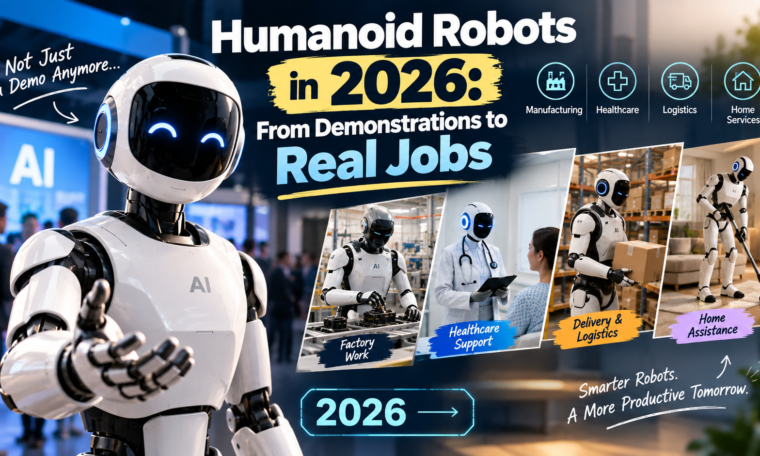
Humanoid robots have moved from science-fiction concepts and impressive demonstrations into a more practical phase in 2026. Instead of simply showing robots walking, dancing, lifting objects, or performing carefully scripted tasks, robotics companies are increasingly testing machines in factories, warehouses, logistics operations, and other real-world environments.
That does not mean humanoid robots are ready to replace workers everywhere. The reality is more measured. Current deployments are concentrated in structured, repetitive jobs where robots can perform clearly defined tasks under controlled conditions. Independent tracking of 2026 deployments shows that automotive plants and logistics facilities are among the most active environments for humanoid robots.
The big question has therefore changed. Instead of asking whether humanoid robots can perform impressive demonstrations, businesses are asking whether they can perform useful work safely, reliably, and economically.
What Are Humanoid Robots?
Humanoid robots are machines designed with a body structure broadly inspired by humans. They may have two legs, two arms, hands, cameras, sensors, and artificial intelligence systems that allow them to interact with their surroundings.
The human-like design has a practical purpose. Many workplaces are already designed around human workers. Shelves, doors, tools, workstations, carts, and production lines are generally built for people.
A robot with a human-like body could potentially operate in these environments without requiring an entire facility to be redesigned.
However, having a human-shaped body does not automatically make a robot capable of doing every human job. Walking, balancing, recognizing objects, manipulating different materials, understanding instructions, and making safe decisions in unpredictable situations remain difficult technical challenges.
From Viral Demonstrations to Workplace Testing
For years, robotics companies attracted attention with videos showing humanoid robots performing remarkable physical movements.
Those demonstrations helped prove that modern robots can walk, balance, manipulate objects, and coordinate movement. Yet a controlled demonstration is very different from working an eight-hour shift in a busy factory.
Real workplaces introduce complications.
A robot may encounter an object it has never seen before. A person may suddenly walk into its path. A box may be positioned incorrectly. Lighting may change. Equipment may malfunction.
Consequently, commercial customers care about measurements that are less exciting than viral videos. They want to know about uptime, safety, reliability, maintenance, task completion, and operating costs.
That shift from demonstration to deployment is one of the most important developments in humanoid robotics in 2026.
Where Are Humanoid Robots Actually Working?
Manufacturing and logistics currently provide some of the clearest opportunities for humanoid robots.
A September 2026 deployment tracker identified 52 named humanoid robot deployments, with 18 located in automotive plants. It also reported that 26 of those deployments were active or pilot programs.
These numbers should be interpreted carefully. A pilot program is not the same as a large-scale commercial fleet. Still, the presence of robots in real operational environments shows that the technology has moved beyond laboratories.
Automotive factories are particularly interesting because many tasks involve repetitive movements, standardized components, and predictable workspaces.
Warehouses offer similar advantages. Robots can potentially move containers, transport items, sort objects, and perform repetitive material-handling tasks.
Humanoid Robots in Manufacturing
Manufacturing may become one of the most important testing grounds for humanoid robotics.
Factories already use traditional industrial robots for highly specialized operations. Humanoid robots are being explored for tasks where flexibility and human-compatible movement could provide an advantage.
Potential applications include:
- Moving parts between workstations
- Loading and unloading materials
- Handling containers
- Inspecting components
- Supplying production lines
- Performing repetitive assembly tasks
- Transporting items around factories
The important distinction is that humanoids are not necessarily replacing specialized machines. Instead, companies are investigating whether a flexible robot can perform several types of tasks in environments where conventional automation may be expensive or difficult to reconfigure.
Humanoid Robots in Warehouses
Warehouses are another promising environment because many activities involve repetitive physical movements.
Agility Robotics’ Digit, for example, has been used in logistics environments, while the company says its next-generation Digit 5 is based on more than 65,000 hours of operation and commercial deployments. Agility announced in September 2026 that it had received more than $300 million in multi-year orders across manufacturing, warehousing, and logistics.
The goal is not simply to make a robot that can walk around a warehouse.
The machine must repeatedly perform useful tasks while working safely around people and equipment. It also needs to be reliable enough for a business to justify the investment.
That is where the robotics industry is facing its biggest test.
What Jobs Can Humanoid Robots Do?
Today’s humanoid robots are most suited to structured and repetitive tasks.
Examples include moving totes, transporting parts, loading items, sorting materials, and performing basic handling operations. A 2026 review of documented deployments found that many real-world applications remain concentrated in logistics and manufacturing rather than the broad range of tasks shown in promotional demonstrations.
Some robots can also perform more complicated activities, but human supervision remains common.
That means the phrase “robot worker” can sometimes create the wrong impression. In many cases, a human is still monitoring the robot, providing assistance, or controlling the machine remotely when it encounters a difficult situation.
Why Humanoid Robots Need Artificial Intelligence
Hardware is only one part of the equation.
A humanoid robot needs AI to understand its environment and determine how to interact with objects and people.
Modern systems can combine cameras, sensors, machine-learning models, motion planning, and other technologies to perform physical tasks.
This area is often described as embodied AI or physical AI.
The idea is simple: instead of AI only generating text or images on a computer, the system uses intelligence to understand and act in the physical world.
That could eventually allow robots to respond to changing environments instead of following a fixed sequence of movements.
However, reliable physical intelligence remains a major challenge.
The Biggest Challenges in 2026
Humanoid robots have made progress, but several obstacles remain.
1. Reliability
A robot that performs a task successfully nine times out of ten may still be unsuitable for a demanding production environment.
Businesses need consistent performance.
2. Safety
Humanoid robots can be large, powerful, and mobile. Working around humans requires careful safety systems.
Agility’s Digit 5, for example, was introduced with a focus on operating near people and detecting human proximity to slow or stop the robot.
3. Cost
Buying, maintaining, charging, updating, and supervising robots can be expensive.
Companies must compare those costs with existing automation and human labor.
4. Dexterity
Human hands are remarkably flexible. Picking up a soft object, manipulating a small component, or handling something unexpectedly shaped can be difficult for a robot.
5. AI Adaptability
A robot trained for one environment may struggle when conditions change.
Real-world workplaces are rarely as predictable as laboratory demonstrations.
Are Humanoid Robots Ready to Replace Human Workers?
The current evidence does not support a simple “yes” or “no” answer.
Humanoid robots are already performing selected tasks in real workplaces, but their deployment remains limited compared with the overall workforce.
Gartner predicted in January 2026 that fewer than 20 companies would scale humanoid robots into production for manufacturing and supply-chain applications by 2028, while most deployments would remain in controlled environments.
That forecast highlights an important point: the technology may be advancing quickly, but widespread deployment requires much more than impressive demonstrations.
For now, humanoid robots are better understood as emerging workplace tools rather than universal replacements for human employees.
Why 2026 Is an Important Year
The significance of 2026 is not that humanoid robots suddenly became capable of doing everything humans can do.
Instead, the industry is becoming more focused on measurable real-world performance.
Investors and businesses increasingly want evidence of actual orders, operational results, safety records, and customer demand. Recent reporting from Reuters also describes a growing focus in China’s humanoid robotics sector on commercial viability and real demand rather than demonstrations and high valuations alone.
That change could help separate genuinely useful robotics companies from projects that depend mainly on publicity.
What Comes Next for Humanoid Robotics?
The next stage will likely focus on improving reliability, reducing costs, increasing autonomy, and expanding the range of tasks robots can perform.
Manufacturers are also working to increase production capacity. For example, UBTech recently announced a factory designed to produce up to 10,000 humanoid robots annually, illustrating the industry’s push toward larger-scale manufacturing.
Still, production capacity alone does not guarantee commercial success.
A company can build thousands of robots, but customers ultimately need machines that solve real problems at an acceptable cost.
Final Thoughts
Humanoid robots in 2026 are moving from impressive demonstrations toward real jobs, but the transition is still in its early stages.
Factories and warehouses are currently among the strongest environments for experimentation because they offer structured spaces and repetitive tasks. Robots can already perform selected material-handling and manufacturing activities, although many deployments remain pilots or supervised operations.
The next major milestone will not simply be another viral robot video. It will be evidence that humanoid robots can work safely, consistently, independently, and economically for long periods.
For businesses, that means the future of humanoid robotics will be measured less by how impressive a robot looks on stage and more by what it can accomplish during an ordinary working day.
In 2026, the robot worker is no longer just a demonstration. It is becoming a workplace experiment—and the results are beginning to matter.