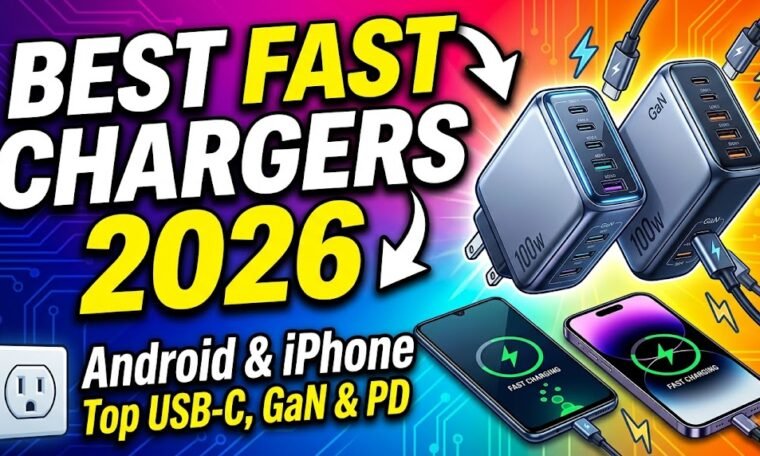
Best Fast Chargers for Android & iPhone in 2026
Nobody likes watching a smartphone battery crawl from 10% to 30% when you’re already late for work, college or a trip. That’s why choosing one of the best fast chargers for Android and iPhone in 2026 can make everyday smartphone use much easier.
Today’s charging market has moved well beyond the old 5W and 10W adapters. Compact USB-C Power Delivery (PD) and GaN chargers can deliver 20W, 30W, 45W, 65W or even more, depending on the device and charger. Current 2026 charger guides highlight USB-C PD and PPS as particularly important standards for broad compatibility and fast charging.
However, there’s an important catch: more watts don’t automatically mean faster charging. Your smartphone, charger, cable and charging protocol all need to work together.
So, which charger should you buy? Let’s look at the best options and how to choose the right one.
What Makes a Fast Charger Different?
A fast charger can provide more power to a compatible smartphone than a basic charger.
You’ll commonly see charging ratings such as:
- 20W
- 25W
- 30W
- 33W
- 45W
- 65W
- 100W+
But don’t assume a 100W charger will charge every phone at 100W.
A smartphone controls how much power it accepts. If your phone supports only 25W charging, a 65W adapter won’t magically turn it into a 65W phone.
That’s why compatibility matters more than maximum wattage.
20W vs 30W vs 45W vs 65W: Which Charger Should You Buy?
20W Chargers
A 20W charger can be a practical option for many iPhone users and basic Android smartphones.
It’s also compact and usually affordable.
Best for:
- iPhones
- Budget Android phones
- Earbuds
- Everyday charging
- Travel
If your phone doesn’t support more than around 20W, spending extra on a 65W charger may not provide a meaningful benefit.
30W Chargers
A 30W USB-C charger is one of the best all-round choices for smartphone users.
It’s powerful enough for many modern phones while remaining compact.
Best for:
- iPhone users
- Google Pixel users
- Mid-range Android phones
- Tablets
- Travel
Current charger testing and buying guides include 30W models from brands such as Anker and Apple, with USB PD and related compatibility features.
45W Chargers
A 45W charger becomes particularly useful for higher-end Android smartphones.
For example, Samsung’s compatible devices can take advantage of 45W Super Fast Charging, provided the charger and cable support the required standards.
Best for:
- Samsung Galaxy phones
- High-end Android devices
- Tablets
- Users wanting faster charging
Samsung’s 45W adapter is among the current options supporting USB PD PPS.
65W Chargers
A 65W charger is ideal if you want one adapter for multiple devices.
You can potentially use it for:
- Smartphone
- Tablet
- Laptop
- Wireless earbuds
- Other USB-C accessories
Modern GaN chargers make these higher-power adapters considerably more compact than many older designs.
Why GaN Chargers Are Popular in 2026
GaN stands for Gallium Nitride.
Instead of relying solely on traditional silicon-based charger technology, GaN allows manufacturers to create compact chargers capable of handling relatively high power.
The result?
A charger can be:
- Smaller
- More portable
- More powerful
- Suitable for multiple devices
Current 2026 Indian charger coverage includes GaN adapters ranging from budget 45W models to high-output 140W multi-port units.
For frequent travellers, this can be extremely convenient.
One compact GaN charger can potentially replace several bulky adapters.
USB-C PD: The Most Important Feature to Check
USB Power Delivery, commonly called USB PD, is a widely used fast-charging standard.
A USB-C PD charger can communicate with a compatible device and negotiate an appropriate charging level.
This makes USB-C PD a particularly useful feature when you’re buying a charger for multiple devices.
Current 2026 charger guides note that USB-C PD has become increasingly common across Android and Apple devices, improving cross-device compatibility.
What Is PPS and Why Does Samsung Need It?
PPS stands for Programmable Power Supply.
It allows compatible chargers and devices to adjust voltage and current more dynamically.
This can be important for Samsung’s higher-speed charging modes.
If you own a compatible Galaxy phone and want its fastest supported charging, look for a charger that specifically lists USB PD PPS rather than simply looking at the wattage.
What About iPhone Fast Charging?
iPhone users should generally focus on USB-C PD-compatible chargers and the charging capabilities of their particular iPhone model.
A 20W charger can be sufficient for many users, while a 30W or higher charger can make sense depending on the iPhone model and whether you also want to charge other devices.
The important point is that buying a 65W charger doesn’t mean your iPhone will continuously receive 65W.
The phone determines the power it accepts.
Can a 65W Charger Damage Your Smartphone?
A reputable 65W USB-C charger should not force 65W into a phone that doesn’t support it.
The charger and device negotiate the appropriate power level.
However, charger quality matters enormously.
Avoid suspiciously cheap chargers with unclear specifications, missing safety information or unknown manufacturers.
A good charger should include appropriate protection against issues such as:
- Overcurrent
- Overvoltage
- Short circuit
- Excess temperature
- Power surges
The Charging Cable Matters Too
Buying an expensive fast charger and pairing it with an unsuitable cable can prevent you from reaching the advertised charging speed.
For higher-power charging, check whether your cable supports the required power and data/charging specifications.
For example, a high-output charger may require a suitable USB-C cable to deliver its maximum capability.
This is particularly important when charging laptops or high-wattage Android phones.
Single-Port vs Multi-Port Chargers
Single-Port Charger
Best when you usually charge one smartphone.
Advantages:
- Simple
- Often smaller
- Maximum power goes to one device
Multi-Port Charger
Better for families, travel or people carrying several gadgets.
You can potentially charge:
- Phone
- Earbuds
- Tablet
- Smartwatch
at the same time.
However, check the power distribution. A charger advertised as 65W doesn’t necessarily provide the full 65W to every port simultaneously.
What Charger Wattage Is Best for You?
Here’s a simple guide:
| User Type | Recommended Charger |
|---|---|
| Basic smartphone user | 20W |
| iPhone user | 20W–30W |
| Everyday Android user | 30W |
| Samsung fast charging | 45W |
| Heavy Android user | 45W–65W |
| Phone + tablet | 45W–65W |
| Phone + laptop | 65W+ |
| Multiple devices | 65W+ multi-port |
The ideal wattage ultimately depends on your devices.
How to Choose a Fast Charger in 2026
Before buying, check these seven things:
1. Maximum Wattage
Make sure it meets your phone’s requirements.
2. USB-C PD
Useful for broad compatibility.
3. PPS
Especially important for certain Samsung devices.
4. GaN Technology
Useful if you want high power in a compact design.
5. Number of Ports
Choose one or more ports based on how many devices you regularly charge.
6. Safety Features
Never compromise here.
7. Brand and Warranty
Choose established manufacturers and reputable sellers.
Common Fast-Charger Buying Mistakes
Buying the Highest Wattage
More power isn’t automatically better.
Ignoring Charging Protocols
PD and PPS can matter more than the number printed on the box.
Using a Poor-Quality Cable
The wrong cable can limit charging performance.
Buying an Extremely Cheap Charger
Safety should come before saving a few hundred rupees.
Ignoring Multi-Port Power Distribution
Check how power is divided when multiple devices are connected.
Final Verdict
The best fast chargers for Android and iPhone in 2026 are not necessarily the chargers with the biggest wattage number. The smartest choice is one that matches your smartphone’s charging capability while offering the right protocol, safety features and portability.
For many users, a 30W USB-C PD charger is an excellent all-round option. Samsung Galaxy owners who want maximum supported charging should consider a compatible 45W PD PPS charger. If you want one adapter for your smartphone, tablet and laptop, a 65W GaN charger can be a much more versatile solution.
The market has also become more convenient. Compact GaN chargers, multi-port adapters and USB-C PD technology mean you can increasingly replace several chargers with one versatile device. Current 2026 buying guides similarly recommend looking beyond wattage and checking charging protocols, port configuration and compatibility