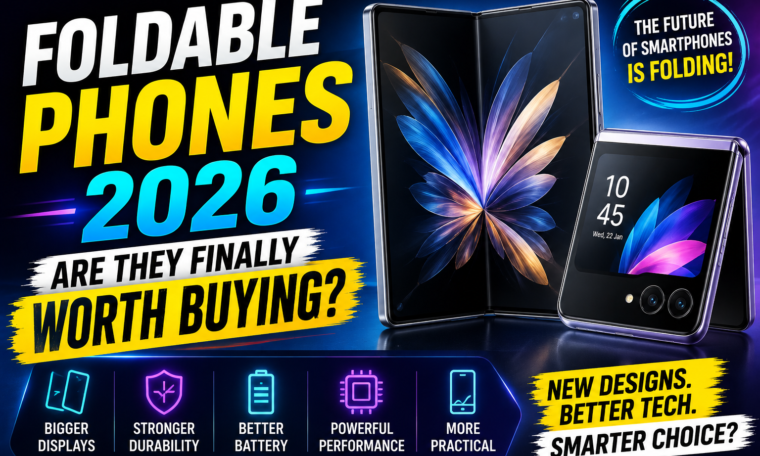
Foldable phones 2026 are no longer the futuristic gadgets they once seemed to be. What started as an expensive experiment has gradually developed into a serious category of smartphones, with manufacturers improving displays, hinges, battery life, software and overall durability.
The biggest question for buyers today is simple: Are foldable phones finally worth buying in 2026?
The answer depends on what you expect from a smartphone. For users who want a larger screen, multitasking and a unique design, modern foldables can offer something traditional smartphones cannot. However, high prices, repair costs, weight and some remaining compromises mean they are still not the obvious choice for everyone.
With Samsung, Google, Motorola and other manufacturers competing in the segment, 2026 is shaping up to be an important year for foldable technology.
What Are Foldable Phones?
Foldable phones use flexible display technology that allows the screen to bend or fold.
There are two major designs dominating the market.
Book-Style Foldables
These open like a book and provide a larger internal display. When closed, they function like a conventional smartphone.
This design is particularly attractive for people who want a phone and small tablet in one device.
Flip Foldables
Flip phones fold vertically into a compact shape.
When closed, they become much smaller and easier to carry. When opened, they provide a regular smartphone-sized display.
Both designs have become more refined in recent years.
How Much Have Foldable Phones Improved in 2026?
One of the biggest changes is that foldables are no longer simply about having a flexible screen.
Manufacturers are now competing on thickness, weight, battery life, cameras, software and durability.
Industry coverage in 2026 describes foldables as thinner, more practical and less compromised than earlier generations.
The latest generation also includes more sophisticated AI features and software designed specifically for larger displays.
This means the technology is moving from “look at this futuristic phone” toward “this phone can actually replace some of the things I use a tablet for.”
Samsung Continues to Lead the Foldable Market
Samsung remains one of the biggest names in foldable smartphones.
Its Galaxy Z series helped establish the modern foldable-phone category, and the company continues to invest heavily in the technology.
In August 2026, Samsung launched its Galaxy Z Fold8 series, including the Z Fold8 Ultra, alongside the Z Flip8. The Fold8 Ultra features an 8-inch display and a 200MP camera, showing how manufacturers are pushing foldables further into premium flagship territory.
For consumers, this means there are now more sophisticated choices than the early generations offered.
Foldable Phones Are Becoming Thinner
Thickness has always been one of the biggest complaints about foldable smartphones.
Early foldables could feel bulky when folded, particularly compared with conventional flagship phones.
Newer designs are much slimmer.
This matters because a foldable phone has to solve two problems at once: it needs to provide a large screen when opened while remaining comfortable enough to carry when closed.
The latest foldable designs show that manufacturers are making meaningful progress in this area.
The Crease Problem Is Getting Better
The crease remains one of the most recognizable characteristics of foldable displays.
When you run your finger across the inner screen, you can still notice the folding area on many models.
However, newer devices have reduced the visual impact.
Some displays make the crease considerably less noticeable during everyday use, particularly when looking directly at the screen.
Is it completely gone?
Not necessarily.
But for many users, it is becoming less of a deal-breaker.
Are Foldable Phones Durable Enough?
Durability is perhaps the biggest concern for anyone considering a foldable phone.
Traditional smartphones have rigid glass displays, while foldables require flexible display technology and moving hinges.
That creates additional engineering challenges.
The good news is that durability has improved substantially.
Modern foldables use more advanced hinge mechanisms and flexible display materials than early models.
However, the inner display can still require more care than a conventional smartphone screen.
This is one reason buyers should pay close attention to warranty coverage and repair options before purchasing.
Battery Life: Has It Improved?
Battery life has also become better, although it depends heavily on the specific device.
A book-style foldable has to power a large internal screen, which can consume significant energy.
Manufacturers are responding with more efficient processors, improved battery technology and better software optimization.
Some 2026 foldables now offer battery performance that is much more competitive with traditional flagship smartphones.
However, battery life should still be one of the first specifications you check.
The Biggest Advantage: A Phone and Tablet in One
This is where foldables can genuinely change how people use their smartphones.
Open a book-style foldable and suddenly you have a much larger screen.
You can:
- Watch videos more comfortably
- Read documents
- Browse websites
- Edit photos
- Use multiple apps
- Work with spreadsheets
- Take notes
- Multitask
For example, you might have a browser open on one side while messaging on the other.
This makes foldables particularly attractive for professionals and people who frequently multitask.
Multitasking Is One of the Biggest Reasons to Buy
Traditional smartphones are excellent for individual tasks.
But when you need to use two or three apps simultaneously, a larger foldable display becomes much more useful.
Modern foldable software is designed around this idea.
Samsung’s latest Fold8 software, for example, supports multitasking across multiple applications and adds AI-related features through its newer One UI experience.
This makes the larger screen more than just a bigger display.
It becomes a productivity tool.
What About Foldable Phone Cameras?
Camera performance remains a mixed area.
Traditional flagship smartphones often have more room for advanced camera systems.
Foldable phones must balance camera hardware with a complicated hinge and flexible-display design.
Some premium foldables now offer excellent cameras, but the best camera phone isn’t necessarily a foldable.
If photography is your number-one priority, compare camera systems carefully rather than assuming an expensive foldable will automatically deliver the best results.
Are Foldables Good for Gaming?
A large internal screen can make gaming more immersive.
Book-style foldables provide additional display space, which can be particularly useful for strategy games, emulators and games with complex interfaces.
However, heat management, battery consumption and software optimization remain important considerations.
A powerful processor alone doesn’t guarantee a perfect gaming experience.
The Biggest Disadvantage: Price
Let’s address the elephant in the room.
The category remains positioned largely in the premium segment. In India, foldables continue to command significantly higher average selling prices than the broader smartphone market. Counterpoint research cited by ET Telecom expects India’s foldable market to remain relatively niche because of high average selling prices, even as shipments grow.
For many consumers, a conventional flagship can offer excellent performance and cameras for less money.
So you’re paying a premium for the form factor and the additional functionality.
Repair Costs Can Also Be Higher
A foldable phone contains more complicated components than a conventional smartphone.
The hinge and flexible internal display can make repairs more complicated and potentially more expensive.
This doesn’t mean every foldable will break.
It simply means buyers should consider the total ownership cost rather than looking only at the launch price.
Insurance, extended warranty and official repair support can be especially important for expensive foldables.
Who Should Buy a Foldable Phone in 2026?
A foldable phone may be worth considering if you:
- Want a large screen without carrying a tablet
- Frequently multitask
- Travel often
- Work from your smartphone
- Enjoy new technology
- Want a premium and distinctive design
- Don’t mind paying more
For these users, the benefits can justify the premium.
Who Should Avoid Foldable Phones?
You may want to stick with a conventional smartphone if you:
- Have a limited budget
- Prioritize camera quality above everything else
- Want the lowest possible repair cost
- Prefer lightweight phones
- Don’t need a large screen
- Are uncomfortable with flexible displays
- Want maximum battery life for the lowest price
There is nothing wrong with choosing a traditional smartphone.
In many cases, it remains the more practical option.
Foldable Phones vs Traditional Smartphones
| Feature | Foldable Phones | Traditional Smartphones |
|---|---|---|
| Display size | Larger when unfolded | Standard |
| Portability | Excellent when folded, depending on model | Generally simpler |
| Multitasking | Excellent on book-style models | Good |
| Durability | Improving but more complex | Generally simpler |
| Repair cost | Potentially higher | Usually easier |
| Camera choice | Varies | Often stronger at flagship level |
| Price | Generally higher | More affordable options |
| Design | Innovative | Conventional |
| Productivity | Excellent on large foldables | Good |
The choice ultimately depends on what matters most to you.
Are Foldable Phones Finally Worth Buying in 2026?
For the first time, the answer is increasingly yes—but not for everyone.
Foldable phones have matured considerably. Better hinges, thinner designs, improved displays, longer battery life and better software have addressed many of the weaknesses that made early foldables difficult to recommend.
The category is also expanding. Samsung remains dominant, while Motorola and Google are competing more aggressively in different segments. India’s foldable market is projected to grow in 2026, even though high prices continue to keep the technology relatively niche.
The important question isn’t whether foldables are better than traditional phones in every category.
They aren’t.
The question is whether their unique advantages are valuable to you.
If you want a smartphone that can transform into a larger productivity device, a foldable can be genuinely useful.
If you simply want the best value, a conventional flagship may still make more sense.
What to Check Before Buying a Foldable Phone
Before spending your money, check these factors:
1. Hinge Quality
Look for a mature hinge design and strong durability reputation.
2. Inner Display
Check the crease, brightness, refresh rate and protective technology.
3. Battery
A large display can consume more power, so battery performance matters.
4. Software
Make sure your frequently used apps work well with the foldable layout.
5. Cameras
Don’t assume expensive means best. Compare actual camera performance.
6. Repair Support
Check official service availability and warranty terms in your country.
7. Weight and Thickness
A foldable can be more convenient when open but less comfortable when folded.
8. Price
Consider whether the larger display and folding design justify the premium.
The Future of Foldable Phones
The foldable market is likely to become even more interesting as manufacturers experiment with new form factors.
Tri-fold smartphones are already entering the conversation, while companies continue working on thinner designs, larger batteries and improved flexible displays.
As competition increases, foldable technology could gradually move into more price segments.
That would be important for mass adoption.
The more affordable foldables become, the easier it will be for consumers to experience the technology without paying ultra-premium prices.
Conclusion
So, are foldable phones finally worth buying in 2026?
For the right buyer, absolutely.
The technology has matured far beyond the first generation of foldables. Today’s devices are thinner, more powerful, more durable and better optimized for multitasking than their predecessors.
However, they still come with compromises. High prices, complicated repairs, flexible-display concerns and varying camera performance mean that traditional smartphones remain the smarter choice for many consumers.
If your priority is productivity, portability and a large screen in a pocketable device, 2026 may finally be one of the best times to buy a foldable phone.
But if you don’t need the folding design, there’s no reason to pay extra simply for novelty.
The future of smartphones may be foldable—but for now, the best phone is still the one that fits your needs and budget.